Chronemics: 5 Dimensions of Time and the Hidden Language of Every Conversation
Chronemics: The Silent Clock That Governs Every Conversation
Imagine two job candidates who answer every interview question correctly. One responds immediately, almost speaking over the interviewer. The other pauses briefly, appears to consider the question, and then answers calmly. Even though their words are identical, the second candidate is usually perceived as more thoughtful, confident, and trustworthy. The difference is timing. This is chronemics in action.
Chronemics is the study of how people use, structure, and interpret time in communication. The term derives from the Greek word chronos (time) and was developed largely through the work of Dr. Thomas J. Bruneau in the 1970s. Bruneau argued that time functions as a communication system, carrying meaning alongside spoken language.
While communication training often focuses on words, tone, and body language, time is an equally powerful but often overlooked element. People constantly interpret temporal cues, usually without conscious awareness. A delayed text reply, a pause before answering a difficult question, or arriving late to a meeting all communicate information beyond the words themselves.
Because expectations about time vary across cultures, organizations, and relationships, chronemics is also one of the most common sources of misunderstanding. What appears respectful and professional in one context may seem rude, disinterested, or inefficient in another.
Chronemics is not merely an academic concept. It influences hiring decisions, workplace relationships, negotiations, romantic interactions, legal proceedings, and everyday family communication. Understanding how time communicates enables people to interpret others more accurately and manage their own impressions more effectively.
Why Time Is a Language
Language is commonly understood as a system that conveys meaning. Time performs a similar function. People routinely assign meaning to delays, pauses, waiting periods, response speeds, and scheduling behavior, even when no words are exchanged.
What makes time particularly powerful is that it is difficult to control consciously. Individuals may carefully choose their words, but their sense of urgency, confidence, patience, or stress often emerges through timing behaviors. As a result, listeners frequently trust temporal cues as indicators of genuine feelings and intentions.
A pause before answering can suggest reflection. An immediate response may signal enthusiasm, urgency, or preparation. A delayed reply can be interpreted as indifference, busyness, caution, or strategic intent depending on the context. In each case, time becomes part of the message itself.
Theoretical Foundations of Chronemics
Chronemics did not emerge in isolation. It grew out of the broader field of nonverbal communication studies that flourished from the 1950s through the 1970s, alongside kinesics (body movement, pioneered by Ray Birdwhistell), proxemics (use of space, pioneered by Edward T. Hall), and paralanguage (vocal qualities apart from words). Edward Hall’s work is especially central to chronemics, because his book on cross-cultural communication, first proposed that cultures organize time itself in fundamentally different ways — an idea chronemics later built on directly.
Edward T. Hall and the Monochronic/Polychronic Distinction
Edward T. Hall’s most influential contribution to chronemics was his distinction between monochronic and polychronic time orientations. This framework helps explain why people from different cultures often have very different expectations regarding punctuality, schedules, meetings, and communication.
At its simplest: Monochronic cultures tend to organize life around the clock, while polychronic cultures tend to organize life around people and relationships.
Monochronic vs. Polychronic Time: Same Situation, Different Mindsets
Imagine a meeting scheduled for 2:00 p.m.
A monochronic person is likely to:
- Arrive a few minutes early.
- Expect the meeting to begin at 2:00 p.m. sharp.
- Become frustrated if the meeting starts late.
- View punctuality as a sign of professionalism and respect.
A polychronic person is likely to:
- Be less concerned about the exact start time.
- Continue an important conversation before joining the meeting.
- View flexibility as normal.
- Place greater importance on maintaining relationships than on following a strict schedule.
Neither approach is inherently better. They simply reflect different cultural assumptions about how time should be organized.
Key Differences Between Monochronic and Polychronic Time
| Question | Monochronic Orientation | Polychronic Orientation |
| What is most important? | Following the schedule | Maintaining relationships |
| How is time viewed? | A limited resource that should be managed carefully | A flexible resource that adapts to circumstances |
| How are tasks handled? | One task at a time | Multiple tasks at once |
| What does lateness usually mean? | Disrespect, poor planning, or lack of professionalism | Often acceptable if relationships or circumstances require flexibility |
| How do meetings work? | Fixed start and end times | Flexible timing and open-ended discussions |
| How are interruptions viewed? | Disruptive and undesirable | Normal and often expected |
| Regions commonly associated | Germany, Switzerland, United States, United Kingdom, Japan (business settings) | Mexico, India, many Middle Eastern countries, and much of Sub-Saharan Africa |
It is important to remember that these categories describe broad cultural tendencies rather than fixed rules. Individuals within the same culture may have very different attitudes toward time.
The 5 Dimensions of Chronemics
Modern chronemics research organizes time-related communication into five major categories. Together, these categories explain how time influences communication at biological, psychological, cultural, interpersonal, and conceptual levels.
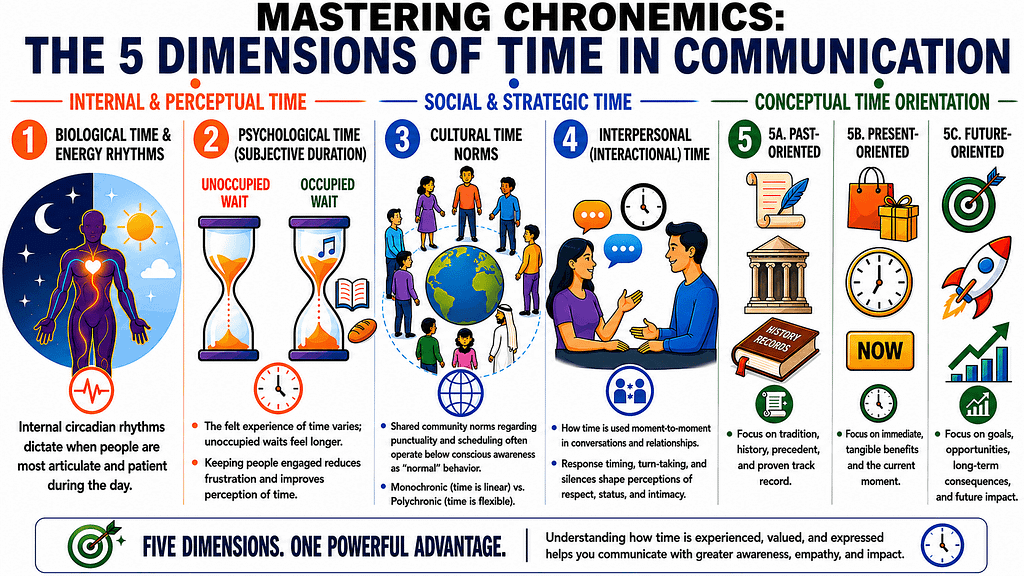
1) Biological Time
Because communication performance fluctuates with natural circadian cycles, the timing of important conversations, presentations, negotiations, and evaluations can significantly influence outcomes — not just what is said, but when it is said.
2) Psychological Time
This principle explains why restaurants provide menus while customers wait, why customer-service systems offer estimated wait times, and why uncertainty often makes delays feel longer than they actually are. Understanding psychological time allows communicators to manage perceptions even when they cannot control the clock itself.
3) Cultural Time
As discussed in Hall’s monochronic and polychronic framework above, different cultures may interpret the same timing behavior very differently. Because these norms often operate unconsciously, cultural time remains one of the most common sources of cross-cultural misunderstanding.
4) Interpersonal (Interactional) Time
This category is particularly important because people frequently interpret timing behaviors as indicators of respect, status, attention, trust, and intimacy. Delayed responses, interruptions, prolonged silences, and unequal distributions of speaking time often communicate meanings beyond the words themselves.
5) Conceptual Time (Past, Present, and Future Orientation)
Recognizing these orientations helps communicators tailor messages more effectively to different audiences and contexts — for example, pairing a future-oriented pitch with concrete near-term milestones when addressing a present-oriented stakeholder.
The five categories of chronemics demonstrate that time is far more than a measurement system. It influences how people think, feel, interact, build relationships, interpret behavior, and make decisions. Understanding these dimensions provides a practical framework for recognizing the hidden role time plays in everyday communication.
Cultural Variation in Chronemics: A Deeper Look
Cross-cultural chronemic miscommunication is so common because most people never question that their own sense of ‘normal’ timing is culturally constructed — not universal.
1) Business Negotiations Across Time Cultures
In Japanese business culture, silence during negotiation signals careful consideration, not disagreement. American negotiators, trained to treat silence as awkward, often rush to fill it with concessions, sometimes weakening their own position without realizing why.
2) Punctuality Norms Around the World
Punctuality expectations vary enormously, even within regions outsiders might lump together as one. The table below shows how the same five-minute delay can damage a relationship in one culture and go completely unnoticed in another.
| Context | Tight Monochronic Norm (example) | Flexible Polychronic Norm (example) |
| Business meeting start | Begin within 1-2 minutes of stated time | Begin 15-30 minutes after stated time without offense |
| Social dinner invitation | Arrive at or near the stated time | Arriving exactly on time can seem too early |
| Reply to a work email | Same business day expected | Within a few days considered reasonable |
| Meeting length | Ends precisely at scheduled time | Extends naturally if conversation is valuable |
Chronemics in the Workplace
Few environments reveal chronemic signaling as clearly as the modern workplace — where timing is read as a proxy for competence, respect, and seniority, often more than the words themselves.
1) Meetings and Status Signaling
Who arrives last is rarely random or unnoticed. A senior leader arriving last while everyone waits is an unspoken status ritual. A junior employee doing the same gets judged far more harshly — because lateness is read through the lens of hierarchy, not in isolation.
2) Email Response Time as a Status Marker
An unwritten response-time hierarchy exists in most offices. Junior staff are expected to reply to seniors within minutes; senior leaders can take hours without consequence. This asymmetry is rarely discussed but widely felt — and new managers often don’t realize a slow reply signals low priority to a direct report.
3) Deadlines, Padding, and Parkinson’s Law
Work expands to fill the time available. Teams given generous deadlines rarely finish early — they use the full window. Experienced project managers exploit this by setting tighter internal deadlines than the real ones, creating a buffer while sharpening team focus.
4) Remote Work and Digital Chronemic Signals
Remote work added a new layer — green “active” dots, “last seen” timestamps, read receipts, and calendar status. These are read automatically and generate strong inferences about availability and priority, even when the reality is completely innocent.
High-Stakes Applications of Chronemics
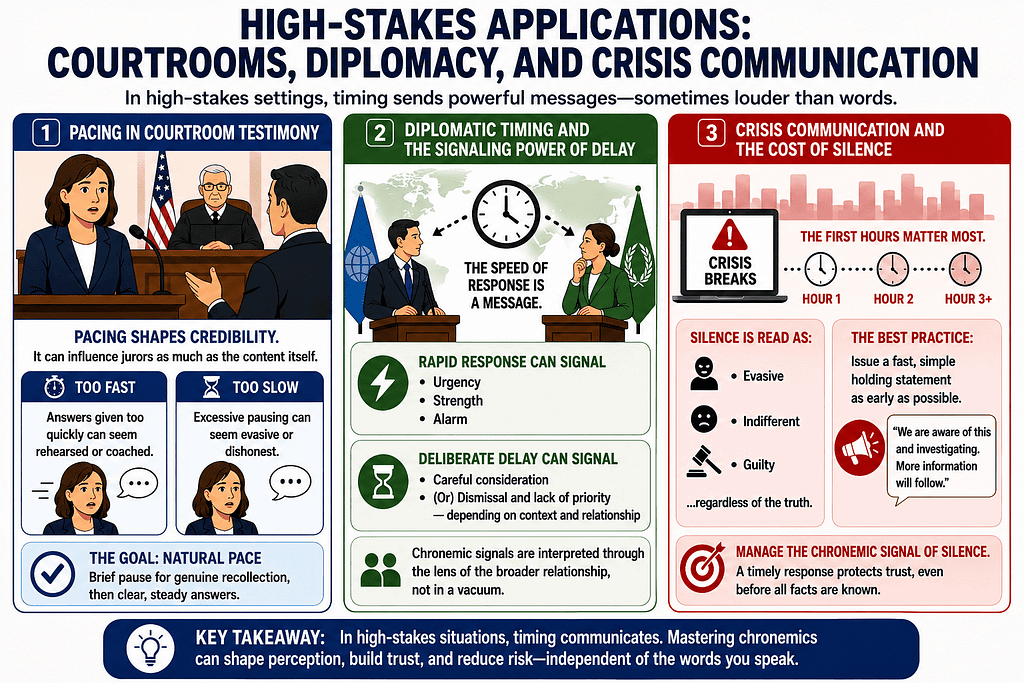
In settings where the consequences of misjudged timing are severe, chronemics moves from an interesting curiosity to a genuinely critical skill. A witness’s pacing can shift juror trust as much as their testimony’s content. A government’s response speed to a crisis or proposal sends its own message, independent of what that response eventually says. And organizations facing a public crisis are judged on how fast they speak up — often more than on what they ultimately reveal — which is why crisis communication training emphasizes a fast, simple holding statement over staying silent while gathering facts.
Practical Guidance: Reading and Managing Chronemic Signals
Understanding the theory behind chronemics is most valuable when it translates into concrete, usable behavior. The following practical guidance distills the research and examples above into actionable steps.
1) How to Read Chronemic Signals in Others
- Notice the gap between what someone says and how quickly or slowly they say it — a mismatch between enthusiastic words and a delayed or hesitant delivery is worth paying attention to.
- Before assuming a delayed reply means disinterest or disrespect, generate at least one mundane alternative explanation (time zone, workload, notification settings, cultural norm) before reacting emotionally.
- Pay attention to who waits for whom in a group setting; it frequently reveals the real, unspoken hierarchy more accurately than job titles do.
- When working across cultures, ask a trusted local contact directly about real punctuality and response-time norms rather than relying on guesswork or your own cultural assumptions.
- Distinguish between a comfortable, thinking pause and an uncomfortable, evasive silence; the first is usually followed by relevant content, the second often by deflection or topic-changing.
2) How to Manage Your Own Chronemic Signals
- In high-stakes conversations, a brief, deliberate pause before answering a hard question typically reads as thoughtful confidence rather than weakness — resist the urge to fill silence reflexively.
- If you must keep someone waiting or respond late, acknowledge the delay explicitly and briefly explain it; an unexplained delay is read far more harshly than an explained one of equal or even greater length.
- If you hold organizational authority, audit your own response-time and punctuality habits honestly; your patterns are likely shaping norms and morale for everyone around you more than you realize.
- In relationships, periodically check whether your chronemic habits (reply speed, punctuality, time devoted) match the message you intend to send, since partners and friends will weigh your timing more heavily than your stated intentions.
- When traveling or working internationally, build in deliberate buffer time and manage your own expectations rather than assuming your home culture’s clock norms travel with you.
3) A Simple Framework for Auditing Chronemic Habits
A useful self-check is to ask three questions about any recurring time-related behavior: First, what is this timing pattern actually communicating to the people experiencing it, independent of my intention? Second, does that message match what I actually want to communicate? Third, if there is a mismatch, what is the smallest adjustment — explanation, scheduling change, or pacing change — that would close the gap? This three-question audit can be applied to a habitually late manager, a slow-replying partner, or a rushed customer service interaction with equal usefulness.
| Chronemic Signal | Common Misread | More Accurate Interpretation (often) |
| Long pause before answering | Evasion or dishonesty | Careful thought, or cultural norm valuing consideration |
| Instant reply to every message | Strong interest and care | Sometimes anxiety, people-pleasing, or lack of other demands on time |
| Slow reply to a text | Disinterest or low priority | Time zone, workload, or a personal style favoring thoughtful replies |
| Arriving late to a meeting | Disrespect for others’ time | Cultural norm, status dynamic, or a genuine, explainable obstacle |
| Meeting running long | Poor planning | Active engagement and relationship-building, in polychronic contexts |
Conclusion: Becoming Fluent in the Language of Time
Chronemics shows that communication extends far beyond words. Every pause, delayed response, late arrival, rushed answer, and culturally influenced understanding of punctuality sends a message that others interpret, often unconsciously. Because people rarely examine their own attitudes toward time, they frequently judge others through assumptions they do not even realize they hold. This makes chronemics both powerful and easily misunderstood.
Time is never neutral — in every example above, timing communicated something about respect, priority, trust, or care, regardless of intention.
Understanding chronemics offers a practical advantage because it makes these hidden messages visible. When individuals recognize the difference between what they intend to communicate and what their timing actually conveys, they can manage interactions more effectively. They can pause thoughtfully, explain delays, respect cultural differences, and avoid unnecessary misunderstandings. In an increasingly connected world shaped by technology, global communication, and constant notifications, fluency in the language of time is an essential skill. It helps build trust, strengthen relationships, reduce conflict, and ensure that people are understood as they truly intend to be.
Thank You!


0 Comments