Body Language Signals That Show Interest, Engagement, or Boredom: How to Spot Them, Read Them, and Act on Them
One of the biggest misunderstandings in the workplace is assuming that if someone is busy, they must also be engaged. That is not always true. An employee can show up every day, complete tasks on time, and appear productive on paper, yet still feel disconnected from their work.
Sometimes, people are simply going through the motions. They do what is required, but their extra effort, creativity, and emotional connection to the job gradually fade.
Research by Gallup (2022–2023) highlights a concerning reality: only about one-third of employees worldwide are truly engaged at work. The rest are either not very interested or, in some cases, actively unhappy and disconnected.
For HR professionals and managers, this is important to understand. If you wait until performance drops or someone suddenly resigns, it is already too late. You have likely missed the early warning signs.
To catch this earlier, managers and HR professionals need to look beyond outputs and start paying attention to employee behavior, especially body language. As, body language provides real-time signals of how employees are actually feeling.
The Science Behind Nonverbal Signals
Body language is not guesswork or intuition. It is rooted in neuroscience.
When a person experiences an emotion, whether it is interest, boredom, stress, or enthusiasm, the brain reacts in a specific sequence.
The limbic system, which governs emotions, activates first. Only after that does the prefrontal cortex, the part responsible for logic, control, and social behavior, step in.
This timing difference is critical. It means the body often reacts before the mind has the chance to regulate or mask that reaction. As a result, physical signals tend to be more authentic than verbal responses.
Paul Ekman’s foundational work on micro-expressions demonstrates that even highly trained individuals involuntarily display their genuine emotional states through brief and sub-second facial movements. These expressions are extremely difficult to suppress or fake.
In a workplace context, this means that an employee who has learned to say, “Yes, I’m engaged,” may still reveal disengagement through micro-expressions, subtle postural shifts, and other involuntary signals that indicate their attention or emotions are elsewhere.
Body Language Is Not Just Reflective, It Is Reinforcing
Research by Amy Cuddy and colleagues at Harvard Business School adds another perspective to this. Their findings suggest that body language does not only reflect internal states, it can also influence them.
While the hormonal claims from Cuddy’s original study have been debated in subsequent research, the broader principle, that physical behavior feeds back into psychological states, is well-supported across the behavioral science literature.
For managers, this means body language is not just something to observe, it is also something that can be actively shaped to influence team energy and engagement.
The Three Layers of Nonverbal Communication
Before analysing specific behavioral patterns, it is essential to understand that employee involvement is not binary. It exists across three distinct states, genuine interest, active engagement, and boredom or disengagement, each reflected in observable clusters of body language signals.
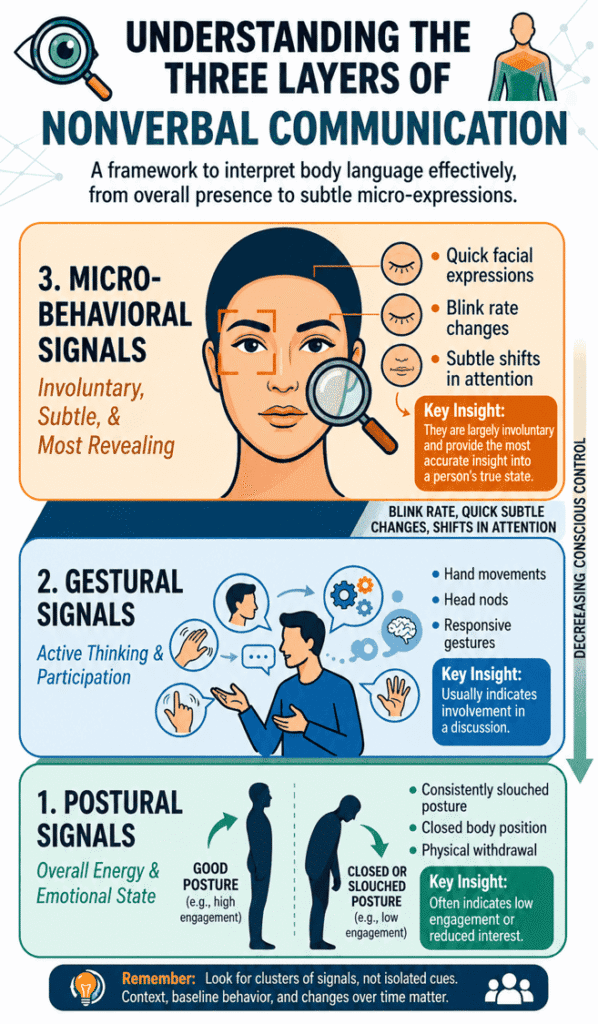
Understanding which layer a signal belongs to helps managers assess both the depth and authenticity of what they are observing.
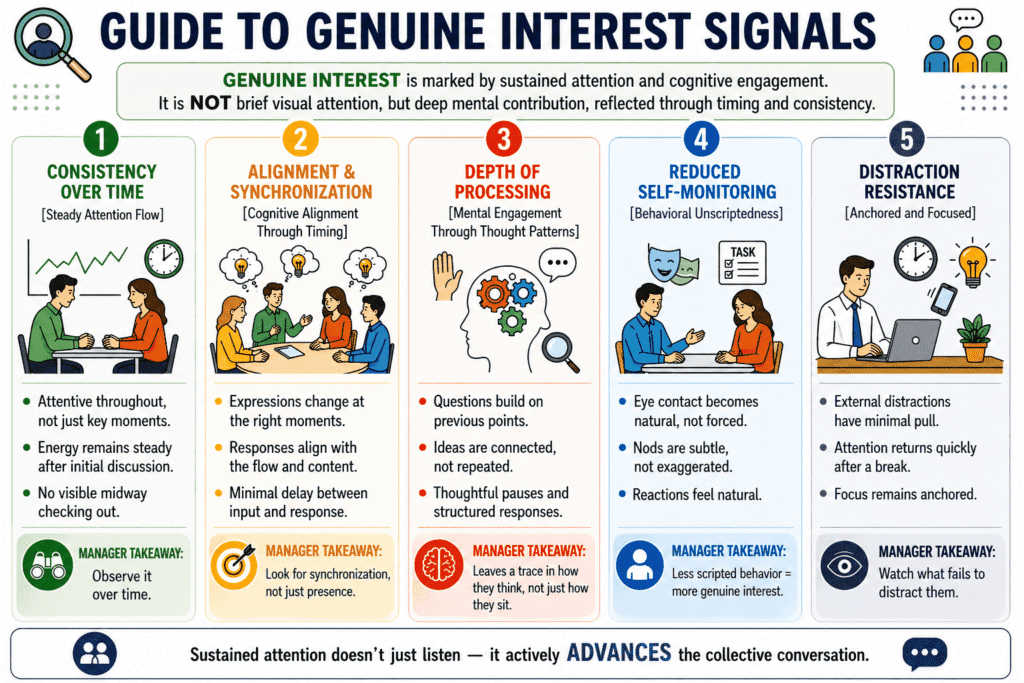
Genuine Interest Signals
Most articles stop at “what interest looks like.” In real work settings, that’s not enough. The real question is whether that interest holds , whether attention stays stable beyond the first few minutes. Because here’s the reality: people can perform attention briefly. Sustained attention is much harder to fake.
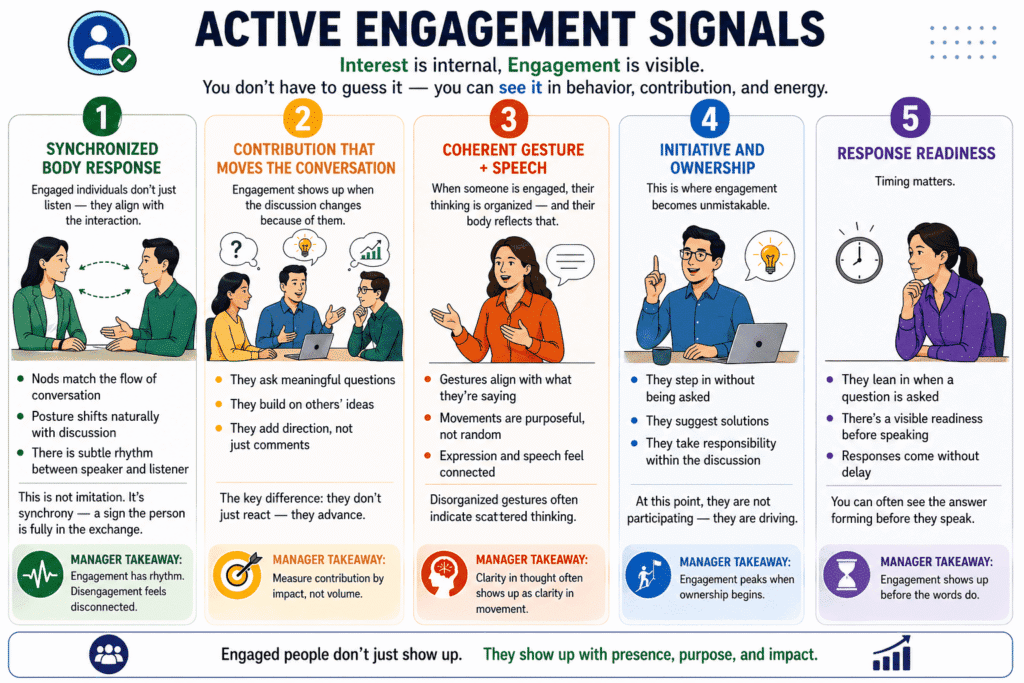
Active Engagement Signals
Interest is internal. Engagement is visible. You don’t have to guess it, it becomes clear through participation, contribution, responsiveness, and the energy someone brings into the interaction.
When engagement is genuine, involvement remains consistent and effort is shown naturally through action.
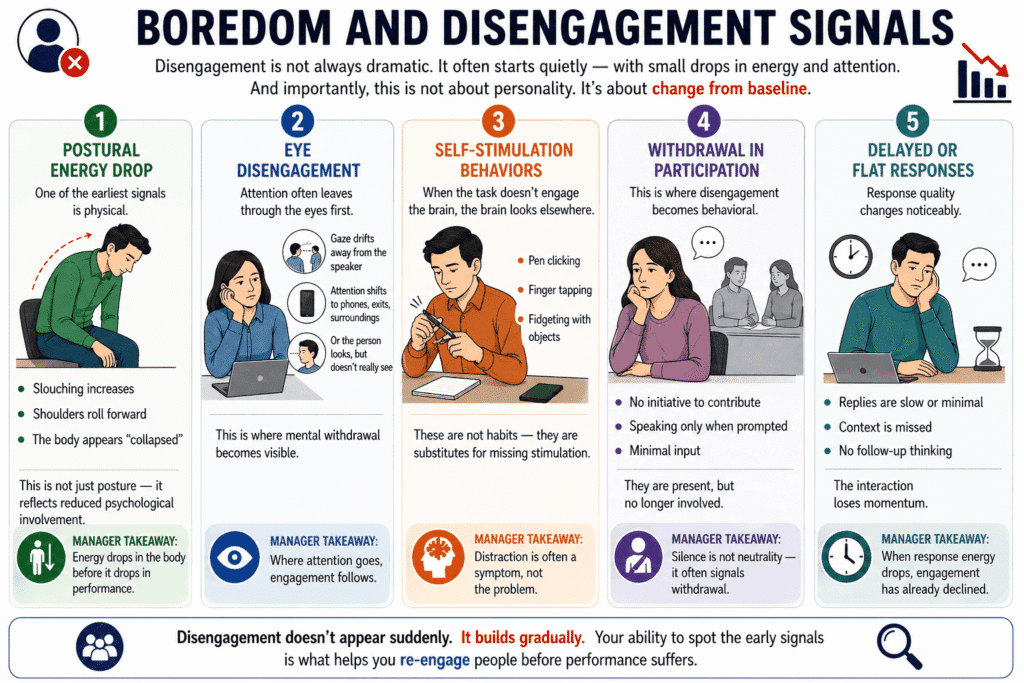
Boredom and Disengagement Signals
Disengagement is not always dramatic. It often starts quietly, with small drops in energy and attention. And importantly, this is not about personality. It’s about change from baseline.
Seven Years of Watching the Same Signals: What the Patterns Actually Taught Me
During my seven years on the job, I noticed that the signals never really changed, but the meaning behind them often did.
And over time, three patterns stood out repeatedly, teaching me lessons I couldn’t ignore.
1. When I Saw Genuine Interest, But No Action
These were the employees who listened carefully, understood deeply, and asked intelligent questions, but rarely stepped forward.
What I initially assumed: “They need more time or confidence.”
What I later realized: This is not a capability gap. It is a conversion gap, attention is not translating into ownership.
What I changed:
- Stopped asking open questions like “Any thoughts?” and replaced them with forced-choice prompts: “Which option would you choose and why?”
- Assigned micro-ownership tasks: “You close this discussion.” “You define the next steps.”
- Introduced low-risk output expectations: drafts instead of final answers, opinions instead of decisions.
The shift that made the difference: I stopped rewarding good thinking and started rewarding visible contribution.
2. When I Saw Active Engagement, But Misalignment
These employees were vocal, energetic, always contributing, and driving conversations.
What I initially assumed: “These are my strongest performers.”
What I later realized: Engagement without direction creates noise, not value. Some were over-contributing without clarity, dominating discussions, or solving the wrong problems, faster than anyone else.
What I changed:
- Introduced constraint-based thinking: “Give me two inputs that actually change the outcome.”
- Defined clear problem boundaries before discussions began.
- Actively managed airtime: “Let’s hear from someone who hasn’t spoken yet.”
- Used them as structured drivers, not free agents.
The shift that made the difference: I stopped encouraging participation blindly and started engineering where that energy goes.
3. When I Saw Disengagement, And Realized It Is Not Always Laziness
These were the hardest cases: low energy, minimal responses, passive presence, gradual withdrawal.
What I initially assumed: “They are not motivated.”
What I later realized: Disengagement is rarely attitude, it is usually misalignment. Task too easy, leads to boredom. Task too complex, leads to avoidance. Task without meaning, leads to withdrawal.
What I changed:
- Replaced generic questions like “What’s wrong?” with diagnostic ones: “Is this too easy, too unclear, or not useful to you?”
- Adjusted task–skill match based on the answer.
- Created forced activation roles in meetings: presenter, summarizer, decision-owner.
- Shortened feedback loops from weekly to daily visibility.
The shift that made the difference: I stopped trying to motivate people and started fixing the system around them.
4. The Insight That Changed Everything
Across all three cases, one pattern stayed consistent, and it reframed how I think about team behavior entirely:
People don’t behave randomly. They respond to how work is structured.
- Interest without action → the structure lacks activation
- Engagement without direction → the structure lacks clarity
- Disengagement → the structure lacks alignment
This means the signals are not really about the employee. They are feedback about the environment.
5. What Changed in My Approach
I no longer ask: “Is this employee engaged or not?”
I ask:
- What is the system making them do?
- What behavior is the current structure reinforcing?
- What one small change in how work is designed will shift this?
The answers are almost always more useful than any motivation conversation.
From Observation to Action: Managing Each State of Engagement
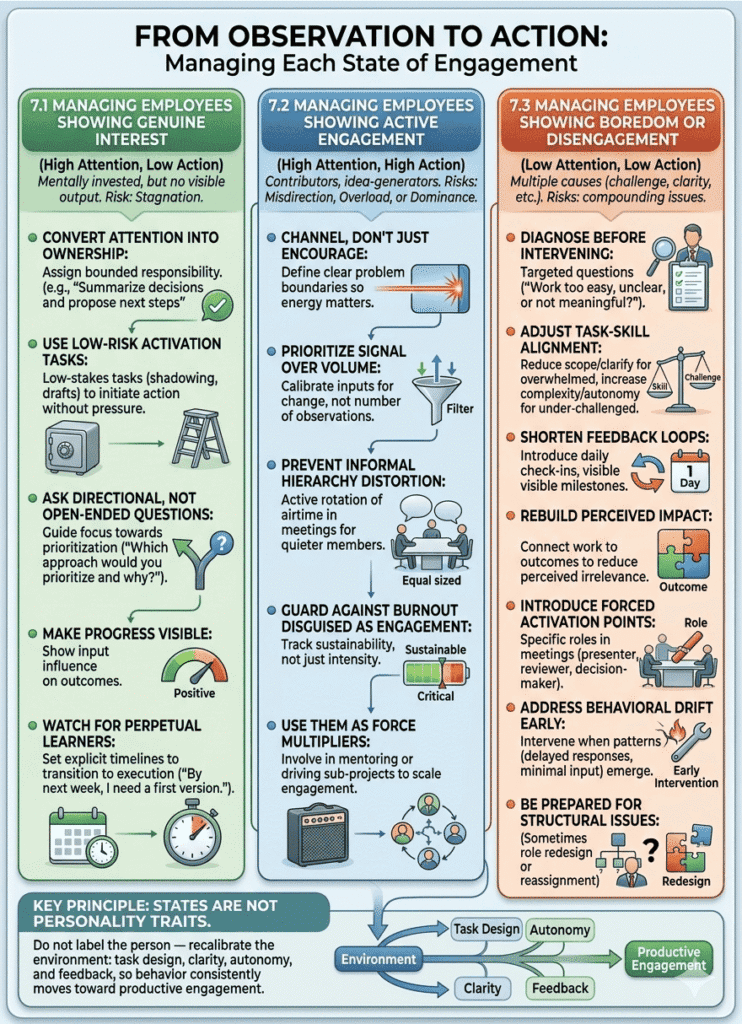
What This Framework Is Really Asking You to Do
Most management training teaches you what to say. Real leadership asks you to do something harder: observe, notice, and interpret before you speak. Your team’s behavior often reveals more than surveys or one-on-ones ever will.
When you see disengagement, don’t ask, “What’s wrong with this person?” Ask, “What is the environment producing, and what needs to change?”
That shift, from judging people to diagnosing situations, is what separates managers who retain strong employees from those who lose them without understanding why.
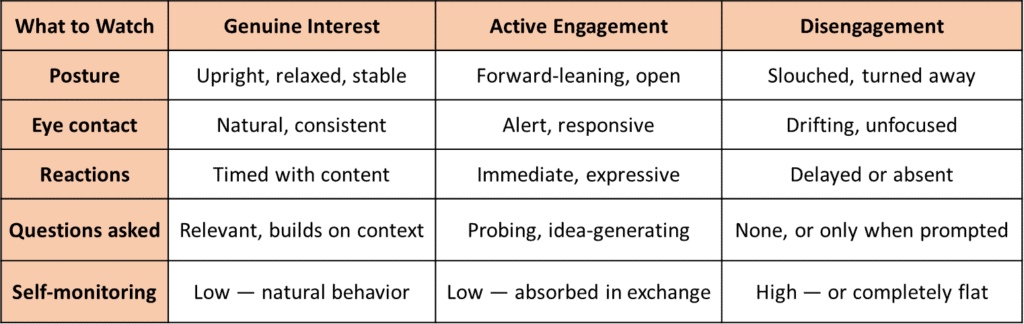
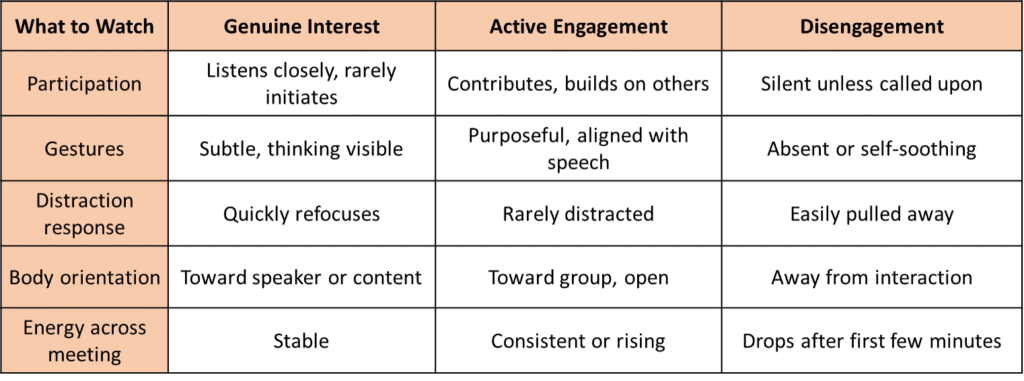
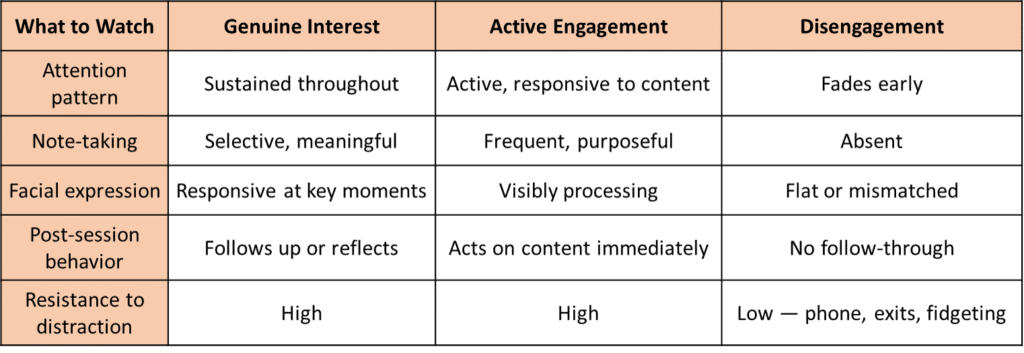
Quick-Reference Observation Checklist
Use this during or immediately after one-on-ones, team meetings, and presentations. Look for clusters of signals, not individual behaviors. Always compare against the individual’s normal baseline.
In One-on-One Conversations
In Team Meetings
In Presentations or Training Sessions
Before You Act on Any Signal, Ask Yourself:
- Is this a cluster or a single signal? One behavior means little. Three or more pointing in the same direction means something worth addressing.
- Is this a change from their baseline? Disengagement in someone usually expressive carries far more weight than in someone naturally reserved.
Conclusion
Engagement is not a survey result. It is not a performance rating. It is not something employees declare in a town hall.
It is visible, every day, in how people sit, respond, react, and move through their work. The signals are always there. The only variable is whether the people responsible for the team are trained to see them.
This piece has covered the science behind why the body reveals what words conceal, the three layers through which nonverbal signals operate, the distinct behavioral patterns of genuine interest, active engagement, and disengagement, and what to do, practically and immediately, when you recognize each state. It has also shown, through seven years of real experience, that the most common mistakes managers make are not about missing the signals, they are about misreading what those signals mean.
The framework is not about surveillance or judgment. It is about paying better attention so that small problems get addressed before they become expensive ones, before the resignation letter, before the performance review, before the exit interview that tells you everything you needed to know six months earlier.
The managers who retain good people are not necessarily the most experienced or the most technically skilled. They are the ones who notice and who act on what they notice, early enough to matter.
That is what this framework is asking you to become.
With that, I’ll wrap up this blog here. If you found it useful, feel free to share it with someone on your team who might need it.
Leave a like, comment, and let me know your thoughts. Also, tell me what topics you’d like me to cover in future blogs. Until then, take care and bye.
0 Comments