Honest vs Rehearsed Interview Answers: 5 Signs Recruiters Spot
Honest vs rehearsed interview answers are more than just about answering questions correctly. Recruiters today look beyond qualifications to assess credibility, emotional intelligence, self-awareness, and how genuinely someone communicates. In a competitive job market, many candidates spend hours practicing answers. While preparation is expected, there is a difference between sounding prepared and sounding overly rehearsed.
Recruiters interview hundreds, sometimes thousands, of candidates each year. This gives them a strong instinct for telling genuine responses apart from polished performances. They notice subtle cues – tone, pacing, body language, eye movement, and storytelling depth. Even a technically perfect answer can feel unnatural if the delivery seems scripted.
More than perfection, recruiters want to understand how candidates think, solve problems, handle pressure, and learn from mistakes. This article explores the verbal and nonverbal cues recruiters use to assess authenticity and evaluate sincerity during interviews.
Why Honest vs Rehearsed Interview Answers Matter
Authenticity in interviews is more than honesty or “being yourself.” It directly affects hiring quality, team dynamics, and long-term workplace success. Recruiters value authentic communication because it helps them assess how candidates actually think, respond under pressure, and fit within a team.
Research on impression management in job interviews examines how candidates manage the way they present themselves during the hiring process.
Overly rehearsed answers create the opposite effect. Instead of revealing genuine judgment and decision-making, they often present a polished performance that hides how a candidate naturally operates in real-world situations.
This plays out in four specific ways:
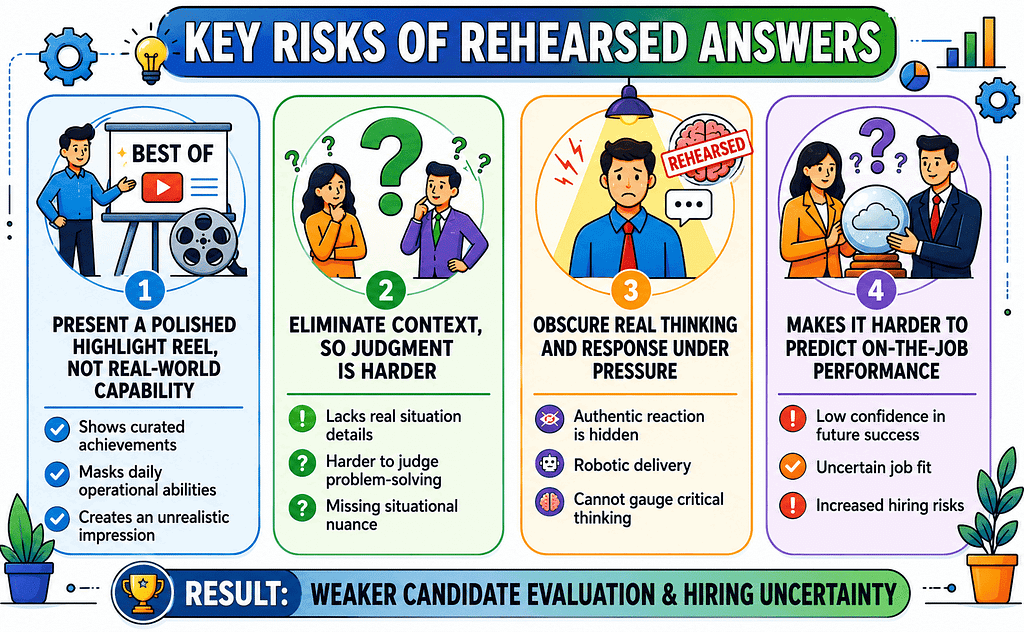
1) Rehearsed Answers Can Hide Real Capability
A perfectly polished answer often functions like a professional highlight reel. The problem is that real work is rarely polished – it is messy, ambiguous, and full of uncertainty. When every response sounds perfectly constructed, recruiters struggle to see how the candidate will actually behave under pressure.
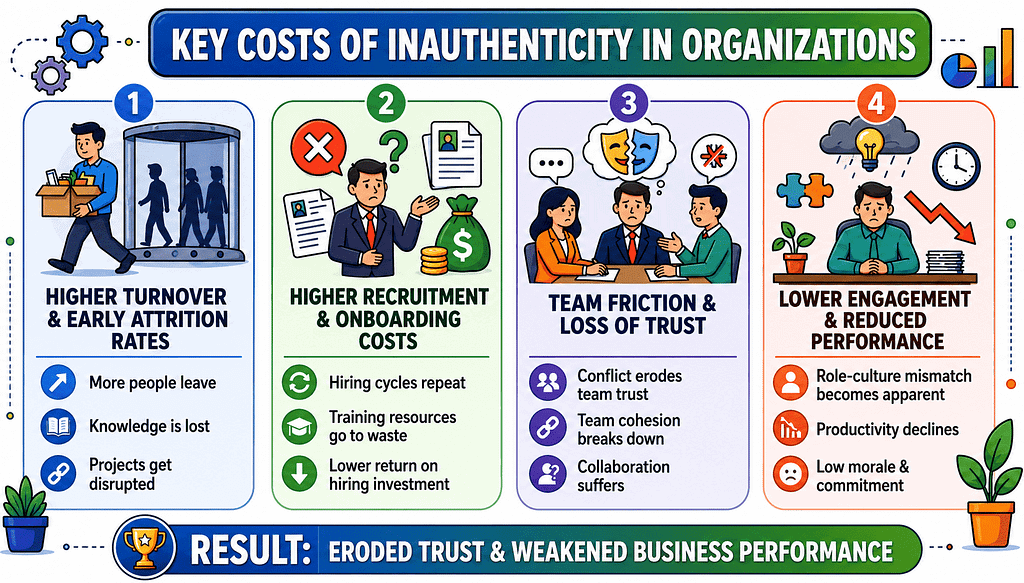
2) Authenticity Supports Better Cultural Fit and Retention
Research in organizational psychology consistently shows that employees perform better when they can work authentically. Candidates who over-perform a “professional persona” often end up in roles that do not suit them, and that mismatch usually becomes apparent quickly after joining. Authenticity improves hiring accuracy because it creates a more realistic picture of long-term fit.
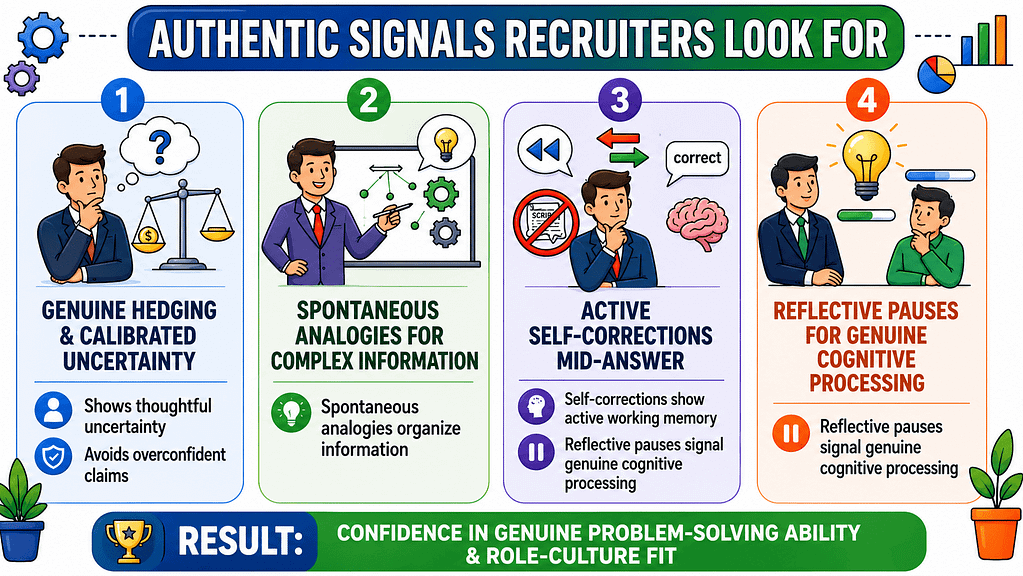
3) How Honest Interview Answers Reveal Real Thinking Patterns
Authentic answers help recruiters understand how candidates actually think. Things like natural hedging, self-corrections mid-answer, and moments of genuine uncertainty followed by thoughtful reasoning tell recruiter far more than a perfectly structured response. Comments like “Looking back, I think the real issue was…” signal genuine reflection, and that is usually a stronger indicator of long-term success than a polished but emotionally flat answer.
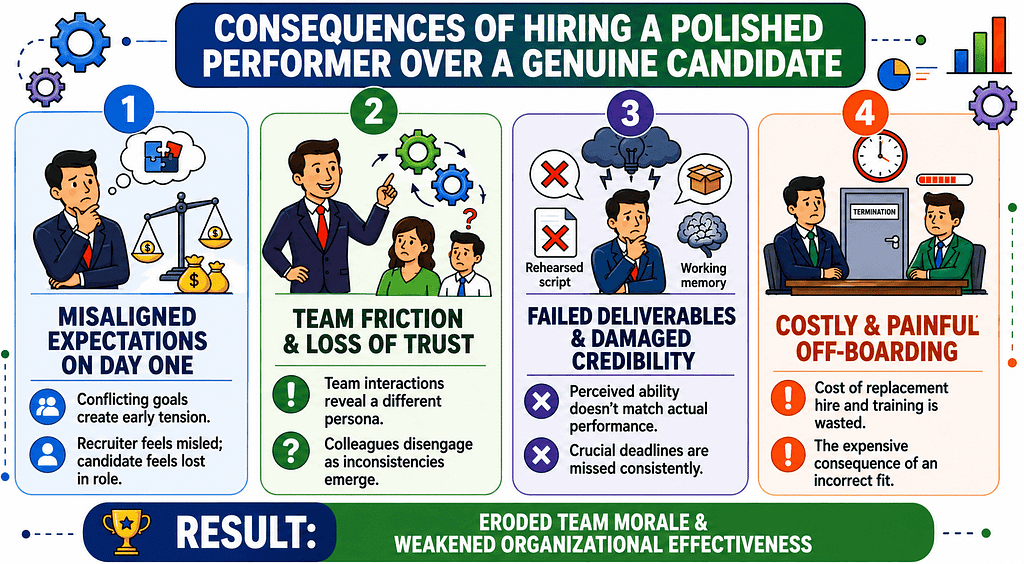
4) The Risks of Rehearsed Interview Answers
Hiring an authentic candidate with a few rough edges is usually manageable – they may simply need coaching, onboarding support, or time to adapt. Hiring someone who presents a polished but inaccurate version of themselves carries much greater risk. Because of this imbalance, recruiters actively look beyond polished delivery to understand the real person behind the answer.
What Rehearsed Interview Answers Sound Like
Rehearsed answers have a recognisable texture. With experience, recruiters learn to distinguish genuine recall from polished performance. These are the five patterns that experienced recruiters notice most:
1) The STAR Overload: Frameworks like STAR are useful – until every answer arrives in the same polished structure, with the same pacing and emotional tone.
- Real stories are uneven; people naturally linger on difficult moments and move quickly through resolutions.
- Perfect pacing across every answer often signals preparation rather than lived experience.
- One polished STAR answer signals preparation. Five identical ones signal a script.
2) Suspiciously Precise Metrics: Authentic recall is usually approximate.
- “Around six or seven weeks” sounds more believable than perfectly calibrated numbers in every answer.
- Real work rarely produces clean, memorable metrics for every situation.
- Candidates who naturally hedge uncertainty often sound more credible than those who recall every detail with total precision.
3) The vocabulary mismatch: One of the clearest signals of rehearsal is a sudden shift in language.
- Candidates who speak casually in conversation but suddenly switch to heavy corporate jargon often sound scripted.
- Phrases like “leveraging cross-functional synergies” frequently feel imported from prep guides or AI-generated templates.
- Authentic answers usually remain tonally consistent throughout the interview.
4) The answer that doesn’t fully fit the question: Memorised answers are built for generic interview prompts. Problems appear when the real question is more specific or differently framed.
- The response sounds related, but never fully addresses what was actually asked.
- Candidates relying on preparation often force a pre-built story into the conversation.
- Authentic candidates adjust in real time instead of trying to make a rehearsed answer fit.
5) The absence of genuine difficulty: Real professional challenges involve uncertainty, frustration, and imperfect decisions.
- Rehearsed answers often follow an overly clean arc: problem identified, solution applied, lesson learned.
- Failure stories that contain no uncertainty or emotional tension rarely feel believable.
- Authentic answers usually include unresolved moments, discomfort, or reflection about what could have been handled differently.
Case Study: Honest vs Rehearsed Interview Answers
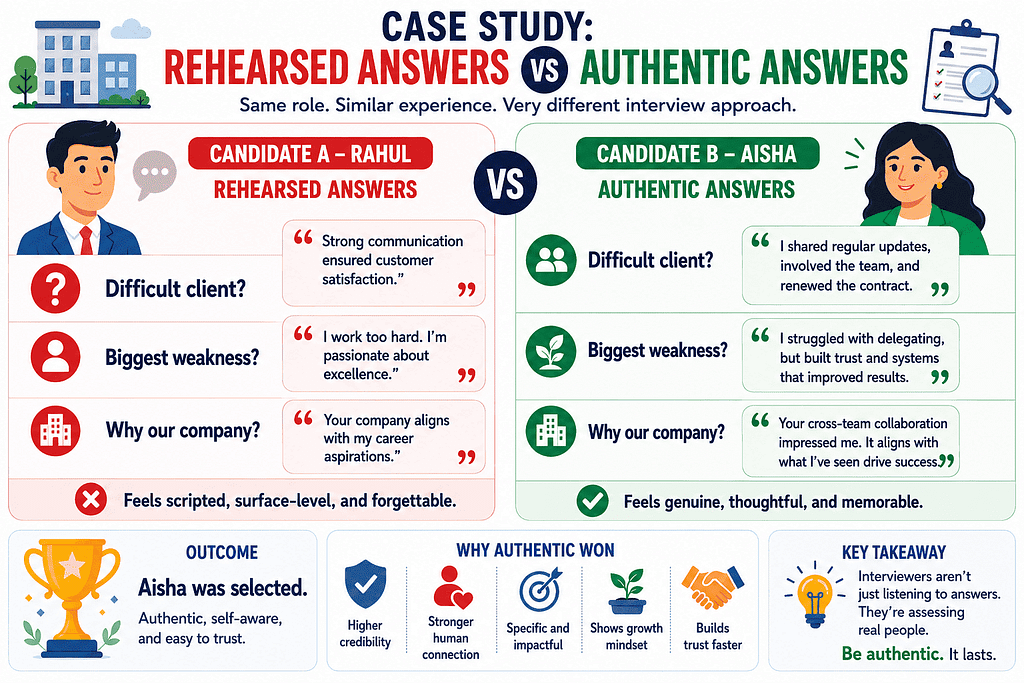
Rahul and Aisha illustrate a pattern recruiters encounter frequently. Both candidates were qualified, but they communicated very differently.
Rahul’s answers were polished, technically correct, and carefully structured – but emotionally flat and overly safe. Aisha’s answers were less polished but more specific, reflective, and believable.
The difference was not intelligence or experience. It was authenticity. Recruiters are usually more persuaded by candidates who sound genuinely engaged with their own experiences than by candidates who deliver perfectly constructed responses.
Verbal Signs of Honest Interview Answers
Rehearsed answers sound produced. Authentic answers sound human. Here’s what to listen for:
1) Self-correction mid-answer
- When someone genuinely remembers something, they circle back and revise.
- “Actually wait – I think I went to my manager first, not the director” – that’s real memory working in real time.
- Scripted answers never self-correct because there’s nothing to fix – it was memorised exactly as intended.
2) Saying “I think” and “I’m not sure”
- Real candidates hedge naturally – “I believe it was around three months” or “I may be misremembering the sequence”.
- This isn’t weak preparation – it’s honest memory.
- Rehearsed candidates rarely hedge because their script has no gaps or fuzzy edges.
3) Odd, specific details nobody would bother inventing
- Genuine answers include small throwaway details – “it was a Friday, which made it worse because we’d just finished our quarterly review”.
- These details add nothing to the story’s headline – which is exactly why they’re believable.
- Rehearsed answers stick to clean metrics and tidy summaries. Real ones don’t.
4) Thinking out loud
- “Let me think about that…” followed by an actual pause – that’s authentic engagement.
- “I hadn’t framed it that way before, but I think what was really happening was…” shows live thinking, not retrieval.
- Don’t rush to fill the silence. That pause is valuable.
5) Comfort with “I don’t know”
- Over-rehearsed candidates feel compelled to answer everything confidently and completely.
- Genuine candidates say “I haven’t faced that exact situation, but here’s how I’d approach it”.
- That honesty reads as self-awareness – one of the strongest indicators of long-term performance.
Body Language Signals in Honest vs Rehearsed Interview Answers
Recruiters aren’t psychologists, and interviews aren’t interrogations. But after hundreds of conversations, most recruiters do develop a general sense of when someone seems at ease versus when something feels slightly off. Body language is part of that – not as a forensic tool, but as one loose signal among many.
It’s worth being clear about what this means in practice. No recruiter is cataloguing micro-expressions or timing your eye movements. What they do notice – usually instinctively rather than analytically – is when someone’s physical presence shifts in ways that feel disconnected from what they’re saying.
1) Comfort and Consistency in Honest vs Rehearsed Interview Answers:
Recruiters usually notice consistency more than any single gesture. The candidates who feel most grounded are often the ones whose energy stays natural from small talk to formal answers.
| What you think you’re projecting | What the recruiter actually sees | What to do instead |
| ✅ Confidence and professionalism | 🚩 Small talk voice and interview voice sound like two different people | Don’t switch modes – carry the same energy from small talk into your first answer. |
| ✅ Taking the interview seriously | 🚩 Shoulders up, tone changes, eye contact drops the moment the first question lands | Take a breath before answering – reset, don’t stiffen. |
| ✅ Focused and prepared | 🚩 The switch from relaxed to stiff happens in real time – and it registers | Remind yourself it’s still a conversation, not a performance. |
2) Gestures and Speech in Honest vs Rehearsed Interview Answers:
When you’re speaking from real experience, gestures follow naturally. When you’re reciting, they don’t – and that gap is something recruiters feel even when they can’t name it.
| What you think you’re projecting | What the recruiter actually sees | What to do instead |
| ✅ Calm and composed | 🚩 Hands completely still during a 3-minute answer – no natural movement at all | Let your hands move naturally – don’t pin them down trying to look composed |
| ✅ Fluent and articulate | 🚩 Answer flows too perfectly – no stumbles, no rephrasing, no “actually wait” | It’s okay to pause, rephrase, or circle back – that’s real thinking, not weakness |
| ✅ Confident delivery | 🚩 Gestures appear during small talk, vanish the moment formal questions begin | Talk about your experience the same way you’d tell a friend – not perform it |
3) Eye Contact in Honest vs Rehearsed Interview Answers:
Eye contact looks most natural when it follows thought, not control. Briefly looking away while recalling something is normal – fixed, unblinking eye contact throughout every answer is usually the bigger red flag.
| What you think you’re projecting | What the recruiter actually sees | What to do instead |
| ✅ Confidence and honesty | 🚩 Fixed, unblinking eye contact for 3 minutes – that’s a script, not confidence | Break eye contact naturally when thinking – look away, find the memory, come back |
| ✅ Engagement | 🚩 Eye contact feels maintained rather than natural | Focus on the conversation, not on “holding” eye contact |
| ✅ Attentiveness | ✅ Looking away briefly mid-sentence – that’s real memory working, not evasiveness | Keep doing this – it reads as genuine, not evasive |
4) Responding to unexpected questions:
Unexpected questions reveal whether someone is thinking in real time – or reaching for something rehearsed. Slight pauses and rougher answers usually feel more genuine than responses that sound instantly polished.
| What you think you’re projecting | What the recruiter actually sees | What to do instead |
| ✅ Handling it smoothly | 🚩 Half-second freeze, then a pivot back to a story already told | Stay with the actual question – a rough genuine answer beats a smooth irrelevant one |
| ✅ Staying composed | 🚩 Smoother answer to the follow-up than the original – that’s the tell | Slow down on follow-ups – think out loud if needed |
| ✅ Being thorough | ✅ Pauses, thinks visibly, gives a rougher but real answer – reads as genuine | Say “let me think about that” – then actually think about it |
5) Nerves in Honest vs Rehearsed Interview Answers:
Nerves affect body language far more than most people realise, and experienced recruiters already account for that. Candidates usually come across as authentic not when they appear perfectly calm, but when their answers feel genuinely connected to real experience.
| What you think you’re projecting | What the recruiter actually sees | What to do instead |
| 🚩 Nerves make you look dishonest | ✅ Shaky voice, fidgeting, rushing – recruiters know nerves instantly | Acknowledge it if it helps – “I’m a little nervous but keen to get into this” lands fine |
| 🚩 Staying calm means you’re doing well | ✅ Nervousness is consistent – rehearsal shows up selectively on certain questions only | Don’t perform calm – focus on the answer, not how you look giving it |
| 🚩 Smooth = credible | ✅ Nervous but specific beats calm but vague – every time | Specific details are your credibility – not your composure |
Emotional Congruence in Honest vs Rehearsed Interview Answers
Recruiters often sense something is off before they can explain why. Most of the time it comes down to this: the emotion doesn’t match the words.
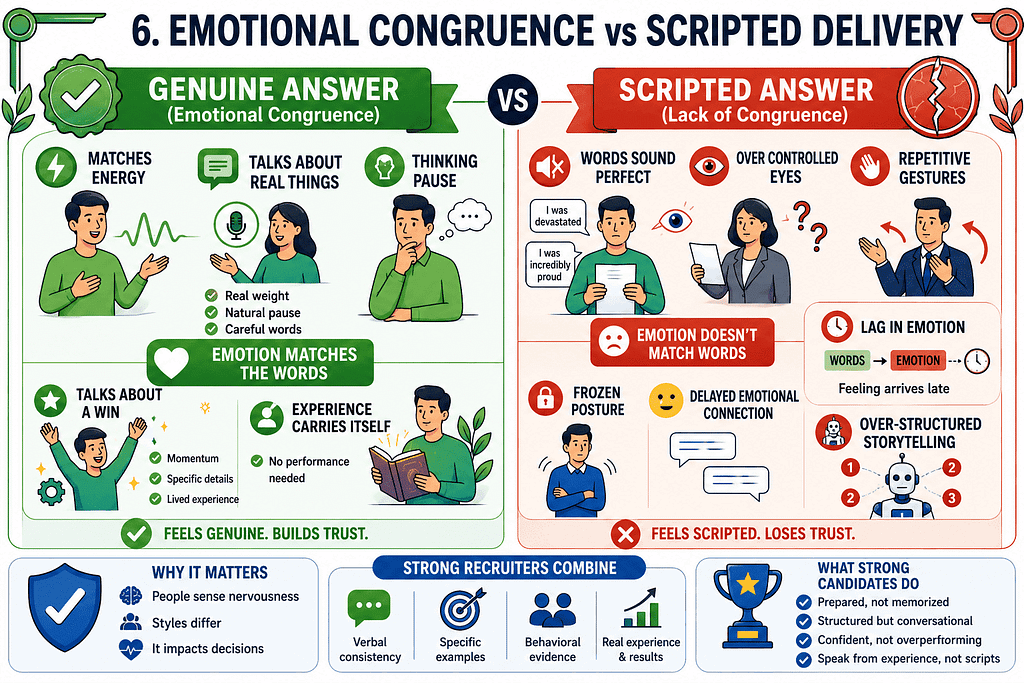
What misalignment looks like:
In scripted delivery, the words and feeling arrive separately. The candidate says “I was devastated” while the face stays neutral, and that small lag between language and affect is one of the most telling signals in the whole interview. Real memory doesn’t work that way. Feeling and words surface together, and the voice and energy naturally match what’s being described: weight in a failure story, momentum in a win. When the emotion has to be consciously added, the timing gives it away. Recruiters register this even when they can’t name what felt off.
Why failure questions reveal the most:
A perfectly smooth failure story is itself the red flag. Real failure is uncomfortable to retell, and that discomfort is proof of its authenticity. Genuine answers tend to leave things unresolved: “I still wonder if I handled that right.” Scripted ones end with a tidy lesson – “I learned that communication is everything” – because the story has been edited for an audience. No ambivalence almost always means no authenticity.
Can Over-Preparation Lead to Rehearsed Interview Answers?
Yes – and in several distinct ways. Here’s where the line falls.
1) The preparation paradox
- Some preparation makes you better: more confident, more articulate, clearer on your own story.
- But too much preparation becomes the problem – you stop speaking from experience and start performing.
- The boundary is easier to cross than most candidates realise.
2) When structure becomes a constraint
- Frameworks like STAR, SOAR, and CAR are useful tools – until they become mandatory templates.
- When every answer gets forced into the same structure regardless of the question, it shows.
- Recruiters don’t flag it loudly, but they notice. Something feels off.
3) The uncanny valley effect
- No preparation = rough but real. Recruiters can work with that.
- Deep, genuine preparation = a pleasure to interview.
- The danger zone is the middle: slick enough to seem polished, but not natural enough to seem real.
- That in-between candidate triggers an instinctive “something’s not right” feeling in recruiters.
4) The confidence trap
- Over-rehearsed candidates actually come across as less confident, not more.
- Every unexpected question becomes a threat – you can see the anxiety.
- Genuinely prepared candidates treat unexpected questions as interesting, not threatening.
- That ease is impossible to fake.
5) The AI answer problem
- More candidates are using AI tools to help prepare interview answers – sometimes too heavily.
- The result can be responses that sound polished, structured, but overly generic.
- Strong answers still need personal detail, reflection, and real experience behind them.
- Recruiters are increasingly recognising when an answer sounds prepared but not fully authentic.
6) What good preparation actually looks like
- Know your own story honestly – what worked, what didn’t, and why.
- Reflect on real moments of difficulty, not to package them neatly, but to understand them.
- Know what kind of work energises you, what kind of manager suits you, what you actually want next.
- Candidates who’ve done this can answer almost anything – because they’re drawing on what they actually lived .
Conclusion: Honest vs Rehearsed Interview Answers
Interviews are imperfect by design – high-pressure, time-limited, and often shaped around performance. In a world where AI can generate polished answers instantly, the gap between how candidates perform and who they actually are is wider than ever.
And yet, authenticity still tends to show through – in thoughtful hesitation, specific details, genuine reflection, and the occasional “I’m not sure.” These are rarely signs of weak preparation. More often, they signal someone thinking from real experience rather than delivering something rehearsed.
For recruiters, the goal was never to catch candidates out. It was always to find the people who will show up to the work the same way they showed up to the interview – curious, self-aware, and genuinely engaged.
Preparation matters. Clear communication matters. But the strongest candidates are the ones who feel present in the conversation, not just ready for it.
Ultimately, great hiring comes down to alignment – between who someone is, how they think, and how they show up in the role.
The next time you’re preparing for an interview, spend less time perfecting your answers and more time remembering the real stories behind them. That’s where the best answers already are.
Thabk You!


0 Comments