The Fascinating Power of Chronemics: Time as a Status Signal
Chronemics: The Clock as a Crown
Chronemics is the study of how time communicates meaning, status, and power. Nobody needs a title to tell you who holds power in a room. Sometimes the clock does it for them.
Most signals of authority are obvious—corner offices, job titles, or who gets to speak first in a meeting. But there’s a quieter signal running beneath all of them: time. Who waits, who gets a quick reply, whose calendar is protected, and who gets interrupted—these everyday moments reveal more about hierarchy than any organizational chart ever could.
This isn’t just an academic curiosity. A colleague who schedules meetings outside your working hours, a manager who takes days to reply while expecting an immediate response from you, or an executive whose schedule everyone else has to accommodate—all of it communicates something, even though nobody says a word.
This piece explores how time quietly shapes our perceptions of power, respect, and priority—at work, at home, and everywhere in between.
A quick note before we go further: none of this is an indictment of people who hold power. Most senior leaders aren’t consciously using time to reinforce their authority; they’re simply operating within habits and norms their organizations established long before they arrived. This piece isn’t about assigning blame. It’s about giving you a framework—and a reason—to notice the pattern, wherever you sit in the hierarchy. If you have power, recognizing these dynamics can help you use it more thoughtfully without requiring extra effort. If you don’t, it can help you stop taking every delayed reply or scheduling conflict personally and start recognizing what is structural rather than personal.
Key takeaway : Time is a language. Learning to read it helps you spot power dynamics that titles alone don’t show.
Chronemics in the Workplace: Whose Time Is Worth More?
Here’s the pattern: in most workplaces, a senior person’s time gets treated as more valuable, harder to interrupt, and more carefully protected than a junior person’s. That’s not usually a deliberate power move — it’s often just how organizations quietly operate.
Three things show up again and again:
- Lateness and meeting control. Senior people’s lateness is often met with greater understanding, and they usually have more say over when meetings start or are rescheduled. But this isn’t always about privilege—many senior people are genuinely juggling packed, back-to-back schedules with little or no slack. The real imbalance isn’t their behavior; it’s who’s expected to absorb the disruption when schedules collide.
- Conversational space. People with more authority tend to get more uninterrupted speaking time, longer pauses, and fewer interruptions. Sometimes that’s just colleagues making room for someone under real time pressure. It only becomes a status issue when that same courtesy isn’t extended to others carrying equally demanding workloads.
- Protected calendars. Senior leaders’ time is often treated as a scarce resource, while junior employees’ time is expected to remain flexible. Often that’s a fair reflection of reality—a senior person’s day really might have less room to move. The problem isn’t that their time is protected. It’s that junior employees’ time is rarely afforded the same level of protection, even when their schedules are just as full.
None of this usually requires a written rule. It simply becomes part of how an organization operates, quietly teaching everyone whose time gets protected and whose isn’t.
Key takeaway : The imbalance isn’t always about ego—it’s about whose schedule gets treated as the fixed point everyone else works around.
Chronemics and the Waiting Room Effect
Nothing illustrates who holds power quite like a waiting room. Doctors’ offices, government counters, and law firms have long relied on this dynamic.
Sociologist Pierre Bourdieu called this a form of domination—making someone wait, with no explanation required. The doctor doesn’t have to explain a forty-minute delay. The act of waiting becomes the explanation.
To be fair, many delays are completely legitimate—a previous patient’s unexpected complications or an urgent case that needs immediate attention. But that’s not really the point. The question is whose time ends up absorbing the day’s unpredictability, regardless of why the delay happened.
Real-Life Example: The Doctor’s Waiting Room
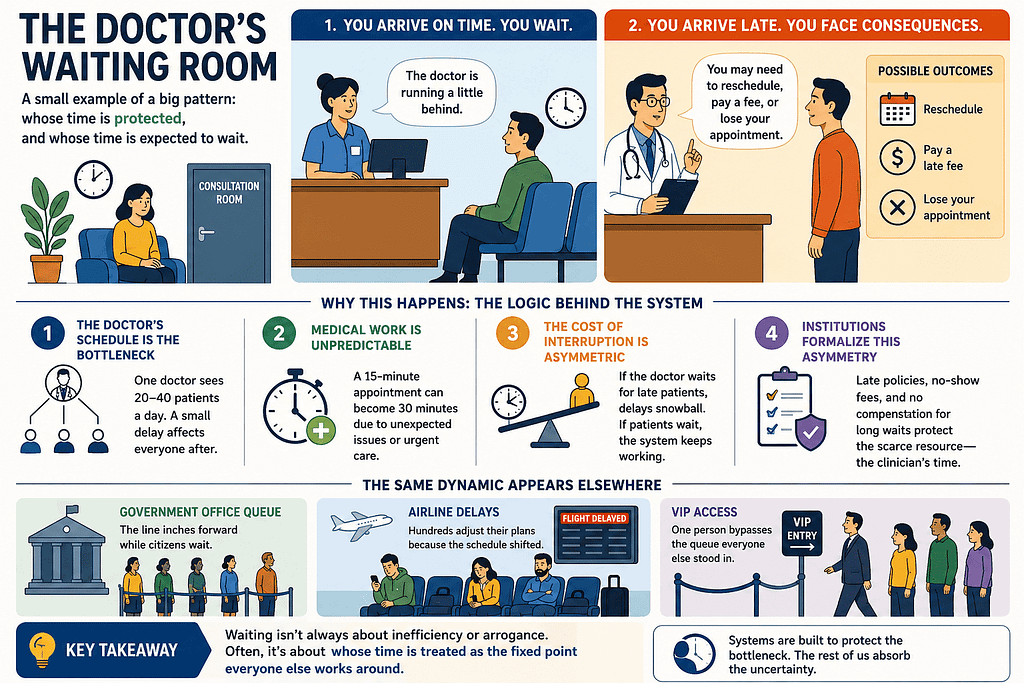
The Office Power Wait
At work, this dynamic becomes almost choreographed. A junior employee arrives on time for a meeting with a senior executive, then waits—sometimes in a chair visible to everyone—until the executive is ready. The visibility is part of the message: being seen waiting communicates something to everyone watching, not just to the two people involved.
Meetings work the same way. A senior leader arrives late, and everyone simply waits—without comment. A junior employee arrives just five minutes late, and suddenly it’s noticed. Much of this really is a consequence of workload rather than ego—senior leaders are often juggling back-to-back meetings that most people never see. But the pattern still holds: people are generally more willing to extend flexibility to those who already hold authority.
Digital Chronemics: The New Status Symbol
If the waiting room was the twentieth century’s power move, your phone is the twenty-first century’s. The gap between sending a message and receiving a reply—whether it’s an email, a text, or a Slack message—has quietly become one of the clearest, yet least discussed, signals of status and priority.
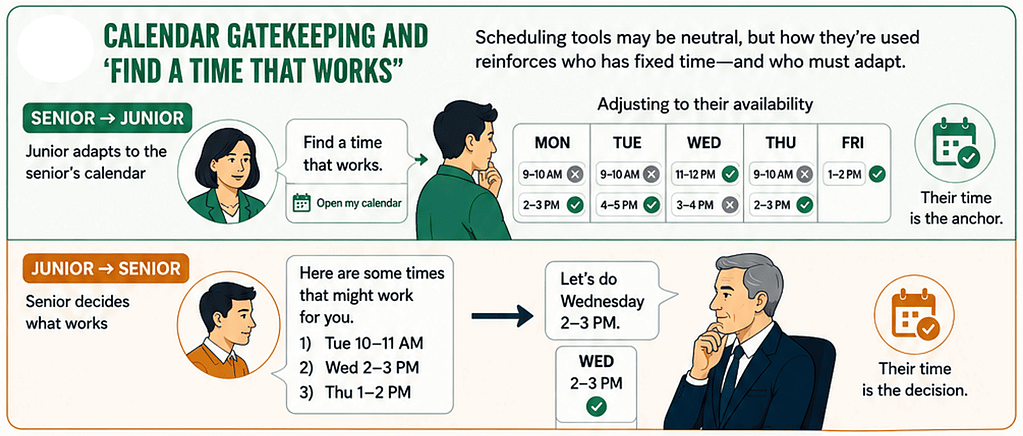
Meeting scheduling reflects the practical realities of organizational coordination rather than individual preference. As responsibilities evolve, employees often manage different workloads, priorities, and decision-making demands. Junior team members may adjust their availability to accommodate existing schedules, while senior leaders frequently balance multiple meetings, cross-functional commitments, and time-sensitive decisions. In this context, calendars become an essential coordination tool that helps organizations use limited time effectively.
Key takeaway: Protected calendars often reflect organizational realities, but they also reveal whose time is treated as the fixed point for everyone else.
Chronemics Across Gender and Culture
Power and time don’t operate the same way for everyone. Gender and culture both influence who gets to control the clock, whose time is valued, and whose flexibility is expected.
1) Chronemics and Gender: Interruptions Aren’t Gender-Neutral
Communication research dating back to Zimmerman and West’s landmark 1975 study—and expanded by decades of subsequent research—suggests that men interrupt women more often in many conversational settings. It also finds that women’s speaking time in mixed-gender meetings is often cut short, even when formal rank is equal.
Sound familiar? Many women describe pitching an idea, getting talked over, and then watching a male colleague repeat the same idea minutes later—only to receive full credit for it. There’s even a name for it: “hepeating.” Chronemically, what’s happening is remarkably clear: one person’s speaking time is reduced, the other’s is expanded, and the redistribution of time starts to look a lot like a redistribution of credit.
2) Time Means Different Things in Different Cultures
Power is expressed through time everywhere—but the “right” way to use it isn’t universal. In schedule-driven business cultures, punctuality and sticking to the agenda are often seen as signs of professionalism. In more relationship-driven cultures, spending time on personal conversation before getting to business is often the stronger signal of respect.
If you work across cultures, don’t assume your interpretation of time is the only correct one. What looks like a delay to you might be an investment in building relationships to someone else—and your strict scheduling might come across as cold or impersonal.
Chronemics and Time Inequality
Everything so far has focused on how people in power control or protect time. But there’s a flip side—how time gets taken from the people with the least ability to resist or reclaim it.
Chronemics and Unpredictable Schedules
Retail workers, food service staff, warehouse employees, and caregivers experience a version of this that has nothing to do with waiting rooms and everything to do with unpredictable scheduling. “Clopening”—closing late and reopening just a few hours later—along with on-call shifts with no guaranteed pay and last-minute schedule changes sent with little or no notice, all send the same message as a long wait outside an executive’s office: your time belongs to the organization. Be available. Don’t complain.
This may be the least visible, yet one of the most damaging, examples in this piece because these workers often have the least power to say no. Much of it stems from genuine business pressures—thin margins, staffing shortages, and unpredictable customer demand. It’s rarely a deliberate power move. Even so, the effect on workers is much the same, regardless of the intent, which is why it deserves attention here.
Real-Life Example:
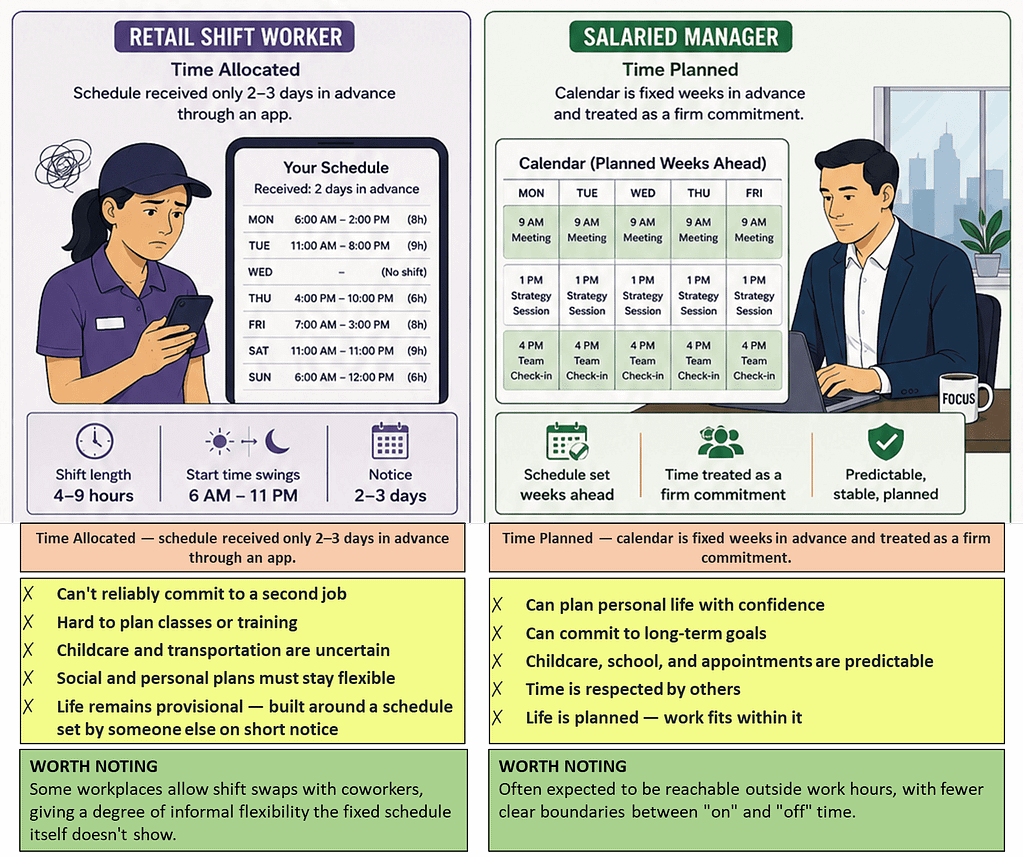
Key takeaway : Unpredictable scheduling isn’t just inconvenient — it’s a structural decision that determines who gets to plan a life and who doesn’t.
Chronemics in Politics: Time as a Political Weapon
Nowhere is this more visible than in international diplomacy, where making someone wait is sometimes a calculated move rather than an accident. History is full of examples of one head of state keeping another waiting, with observers interpreting the delay as a message about who’s really in charge, regardless of what gets said once the meeting begins.
That’s exactly why state visits are timed down to the minute. Of course, many delays are genuinely mundane—traffic, security requirements, or a meeting running long. Not every late arrival is a power play. But here’s the twist: outsiders usually can’t distinguish between an unavoidable delay and an intentional one, so both are often interpreted as signals of status or leverage.
Chronemics in Press Conferences
You see a smaller version of this at press conferences. How long a reporter gets for a follow-up, or whether an official extends or abruptly ends the conference, can signal who currently has leverage. Cutting a press conference short after a tough question can be as much a statement of power as a communication decision: the conversation ends because the person in authority decides it does.
Chronemics in Education
A professor can arrive late, let a lecture run past the bell, or reschedule an exam with a single email—often with no consequences. A student who’s five minutes late? They may be marked absent or even locked out. The pattern continues into graduate school, where a doctoral student waiting twenty minutes outside a professor’s office hardly registers as unusual. The reverse would be remarkable enough to be remembered for years.
To be fair, much of this stems from institutional policies rather than any individual professor’s attitude—back-to-back office hours, research commitments, and rules they didn’t create. But the pattern still teaches the same lesson early: some people’s schedules are treated as flexible, while others are expected to adapt.
Applying Chronemics in Everyday Life
Understanding all this only matters if it changes how you interpret everyday interactions. Instead of assuming every delay or interruption is directed at you personally, start looking for the broader patterns.
Ask yourself:
Who’s expected to wait, and who almost never waits?
● Whose calendar is treated as fixed, and whose is expected to remain flexible?
● Who can show up late or run over time without anyone blinking?
● Whose messages get answered promptly, and whose sit unanswered for days?
● Is this a one-off, or is it a recurring pattern?
One instance doesn’t prove anything. Repeated patterns reveal how power operates.
What to actually do about it:
If you’re the one with more power, treat other people’s time the way you’d want yours treated—start on time, communicate delays as early as possible, and don’t make availability a one-way street. If you’re navigating a hierarchy, set healthy boundaries, communicate early, and don’t take every delay personally. Chronemics isn’t about keeping score. It’s about understanding the room accurately.
Conclusion: The Bottom Line
Power rarely announces itself. It shows up in small, everyday decisions about time—who waits, whose calendar takes priority, who gets an instant reply, and whose deadlines can be moved.
None of this means every late meeting is a calculated slight—many have completely ordinary explanations. The goal isn’t to treat a single incident as proof of anything. It’s to notice recurring patterns.
Time isn’t just something we manage. It’s something we communicate with. Pay attention to it, and you’ll start seeing power dynamics long before they’re spoken aloud.
Thank You!


1 Comment
Body Language in Workplace: 5 Mistakes & 6 Career Tips · August 13, 2026 at 3:34 am
[…] Chronemics: 5 Dimensions of Time and the Hidden Language of Every ConversationPunctuality and Professionalism: Why Being Late Can Damage Your ReputationThe Fascinating Power of Chronemics: Time as a Status Signal […]