The Smile That Lied: When Expressions Hide the Truth
Smile is an expression, which symbolise positivity, warmth and friendliness across the world. From childhood, we are taught: “Smile and things will all work out”.
Now-a-days, whether you are at office or at family function, whether in an interview or with a client, smile has become a default mask. We smile when we’re exhausted. We smile when we’re hurt. And we smile even when we’re silently breaking.
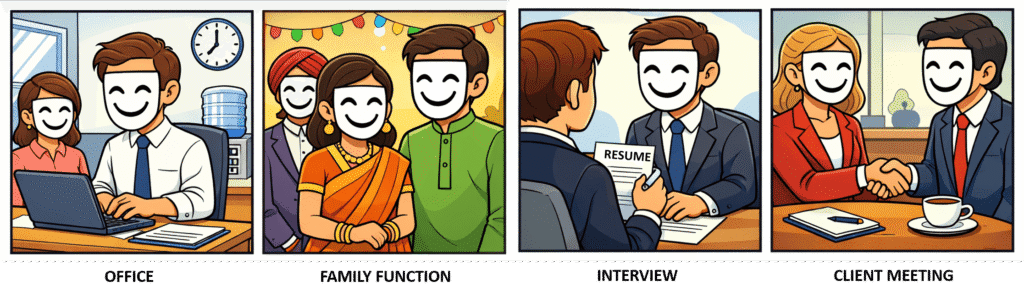
But have you ever wondered…
- What if that smile is lying?
- Does every smile tell the truth?
- Is every smile really a symbol of happiness and joy?
The answer is: NO.
In modern workplaces and at Social environment, a new phenomenon is trending: “The Smile That Lied“.
That means : Smile:
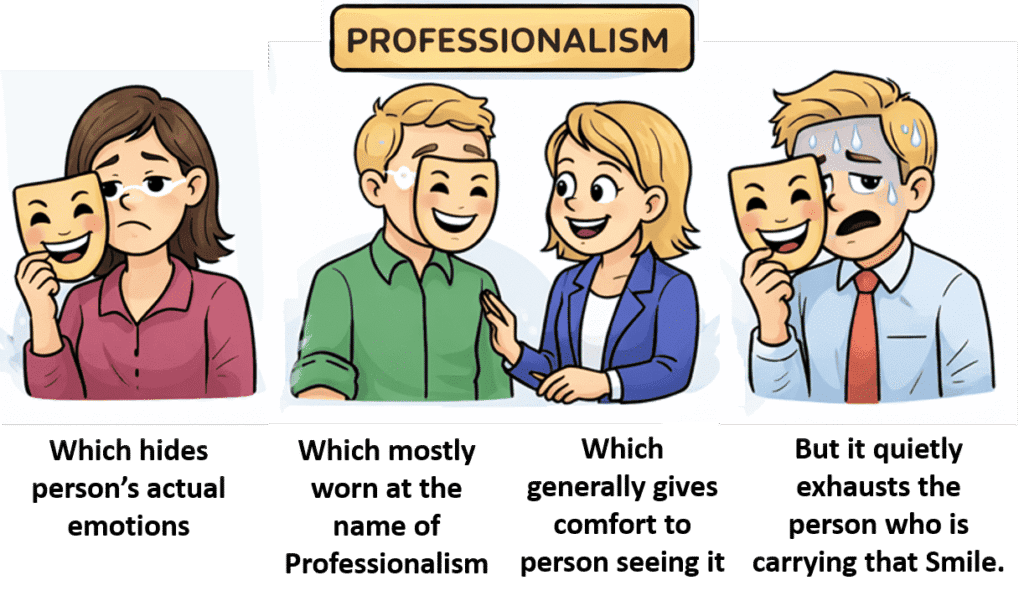
In this blog, we will understand – psychology and science behind smiling, the difference between real & fake smiles, body language cues to identify when a smile is lying, the reality of smiling pressure in the workplace, a real-life inspired case study with practical lessons for HR and leaders on how to handle it.
So let’s begin.
Psychology and Science Behind a Smile : Traditionally, smile is considered as direct indicator of happiness. But, today’s modern psychology and neuroscience tells us that smile is not just an emotional reaction. Many times it is conscious and unconscious strategy which we used to handle social situations.
As per psychology, smile is a powerful social signal . Most of the time , people smile not to show their feelings but to manage situations, like:
- To avoid conflict
- For approval or acceptance at something
- To please authority figures
- To hide one’s insecurity or weakness
- Or just to show normal and composed behaviour
This process in psychology is called Emotional masking or Impression management, where people supress their inner feelings to show socially acceptable expressions. This results person in showing positive smile at outside but inside it create emotional exhaustion.
And from this we can say story starts for: The Smile That Lied.
Scientific Perspective – Role of Brain & Facial Muscles : In our previous blog, we have discussed about how limbic system control the emotions and instantly signals facial muscles, making most facial expressions automatic and uncontrollable. However, when it comes to a smile, the science works a little differently.
As per scientific perspective, the control of a smile is not limited to emotions alone. Our brain has 2 system , which work to produce smile:
- Emotional brain (limbic system): here smile activates naturally due to genuine happiness,
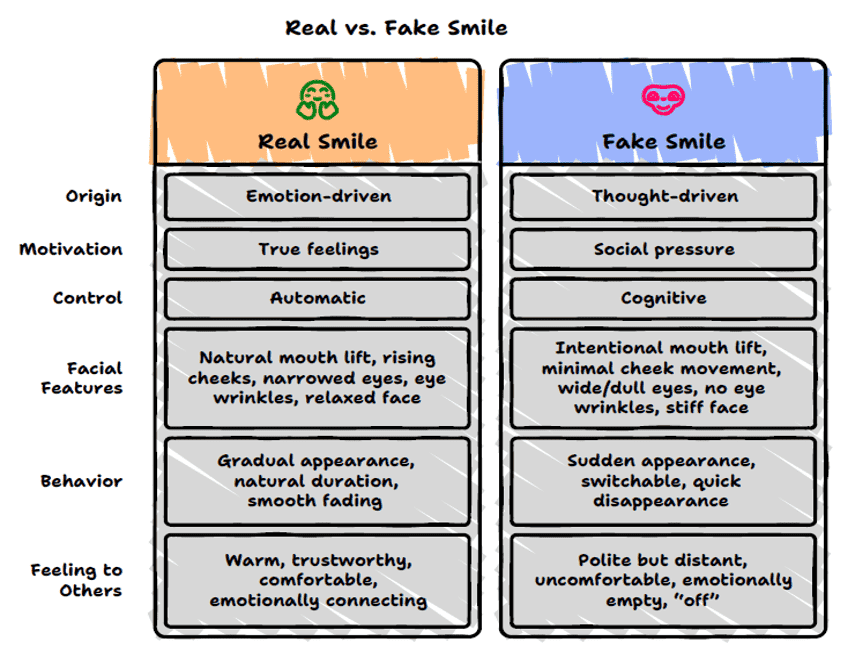
- Cognitive control system : which produces smile through social pressure or from learned behaviour. With this , a person can generate smile without feeling genuine happiness. This involves voluntary activation of the zygomaticus major muscle (facial muscles), which can give the appearance that a person is happy. but without eye-muscle activation, the smile becomes a fake one.
As per neuroscience, repeated fake smiling can confuse brain as it creates mismatch between emotions and facial expresssions like smiling. Over time, this can confuse the brain leading to stress and emotional fatigue to the person wearing the smile.
Difference between Real vs Fake Smile
Why smile starts lying at the workplace?
In today’s professional environment, smile has become an emotional language , which most of the time used to hide truth at the workplace. This comes into habit with years of organizational conditioning, social expectations, and learned emotional control.
Let’s understand why workplace smile lies in detail:
- Professionalism pressure: There is a silent rule in office culture that says :Professionalisms mean calm, composed with smiling demeanour. This rules categorise anger, hurt or confusion to unprofessionalism, that’s why employees generally shield themselves within fake smile.
- Conflict avoidance : Generally, many employees smile to avoid confrontation or reduce conflict. This is also done to avoid relationship damage among teammates. Thus, many employees smile even when they disagrees with team or other members. This smile only show forced or fake support not a genuine agreement.
- Power imbalance : In today’s environment, smiling in front of boss, senior or authority, has become a defences mechanism for most employees. Most of the time, when employee feels uncomfortable but due to power and authority gap, unable to speak up, they just give a smile, showing – everything is fine, where in reality they are in deep uncomfortable state.
- Fear of Judgement : At workplace,people often judge others based on their attitude, tone and reaction. This fear and pressure makes employees to hide their true feelings and emotions . They use smile as a socially acceptable expression and to avoid and protect themselves from constant judgement.
- Culture of Being Positive : Sometimes, motivational lines like : Stay Positive, Don’t become Negative, becomes a tool for suppression. Where discussing a problem becomes a difficult task. In such cases, a person forces a smile but unable to discuss about the ongoing problem.
- Emotional Labour : In customer facing or in corporate roles, employees are expected to be in pleasant behaviour. It doesn’t matter, whether an employee is feeling burnout, having personal issue or any kind of stress – A smile is must. Use example of an airhostess. This force smile gradually becomes a lie as it don’t represent real emotions.
At workplace, Fake smile is not a choice, it’s a compulsion. Real professionalism doesn’t means just pass smile on others in every situation. It is more than that , like – having safe expressions, honest communication and emotional respect and an organisation can achieve that by giving space to certain level of emotions at the workplace.
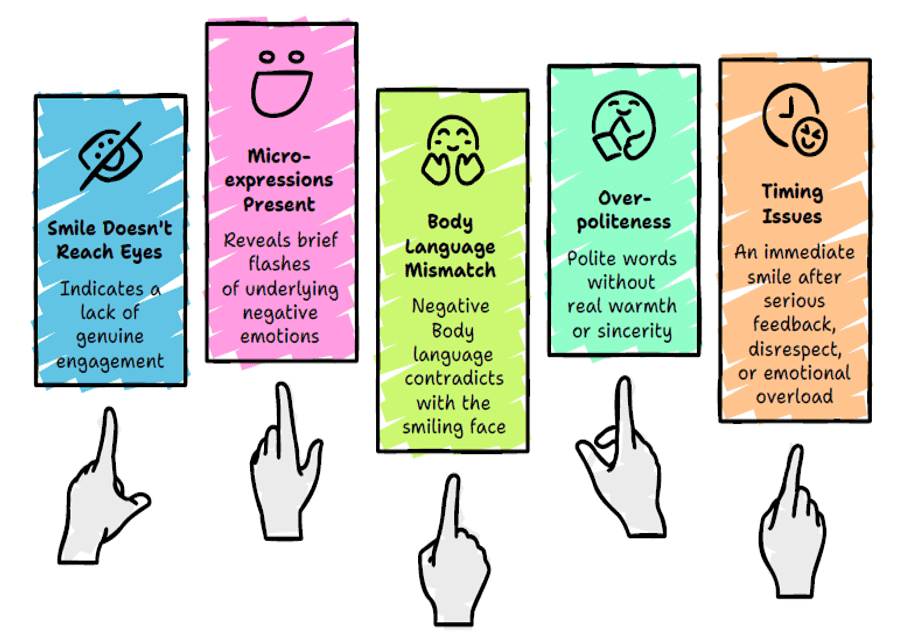
Signals (How to Identify When a Smile Is Lying)
Case Study: Eli is a cabin crew member working on long-haul international flights. She’s the kind of professional who does everything as per script, like: warm greetings, polite language, perfect service. Passengers hear “Welcome aboard!” and “There’s nothing to worry about” delivered with a smile.
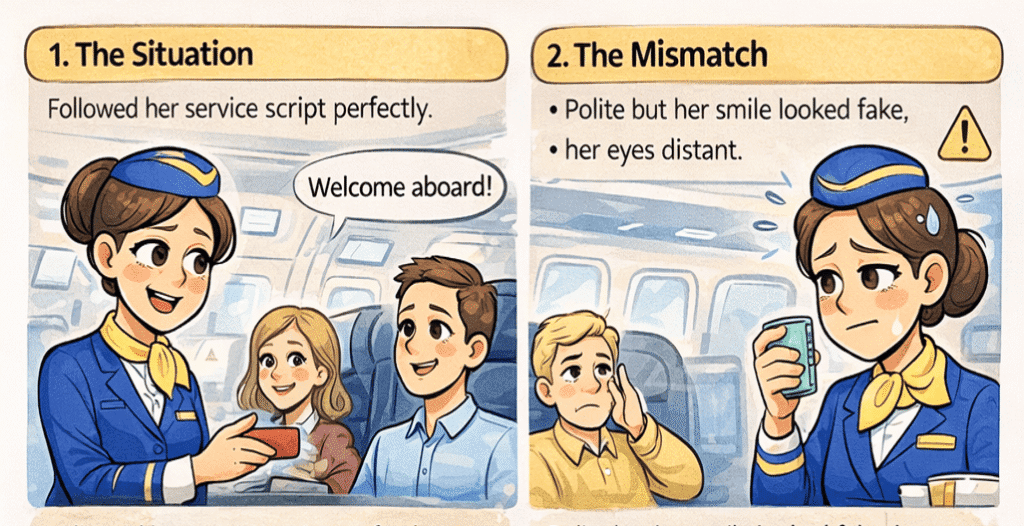
But here’s the thing: her smile doesn’t quite reach her eyes. Her eyes looks tired & distant. And the moment she turns away from a passenger, her perfect smile vanishes completely.
So, what do you think passengers pick up on?
Despite hearing all the right words, they sense something is off. There’s a disconnect. Her polite responses feel rehearsed rather than genuine. Passengers feel emotional distance instead of genuine care. They might not be able to put their finger on it, but they know her reassurance doesn’t feel real.
Here’s the truth behind the smile:
Eli isn’t being fake on purpose. Behind the scenes, Eli was dealing with:
- Chronic fatigue due to night flights and jet lag
- Emotional strain from handling aggressive passengers
- Pressure to pass grooming and behavior checks
- Loneliness from being away from family
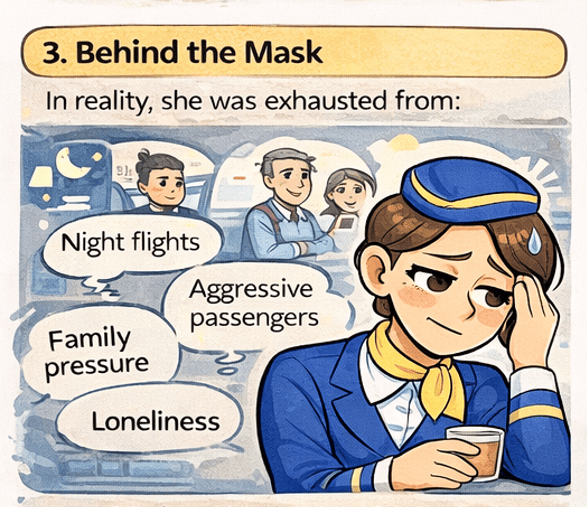
She had learned to say the right things, but her emotional system was depleted. Her smile was no longer emotional, it was cognitive, produced out of duty, not feeling.
Her zygomatic muscles moved, but her eyes stayed disengaged.
The lesson? Eli wasn’t lying. Her smile was.
You can train someone to say the right words, but you can’t train emotions. When what we say doesn’t match what we feel, people instinctively sense it. Eli’s smile didn’t mean happiness, it meant she was barely holding on.
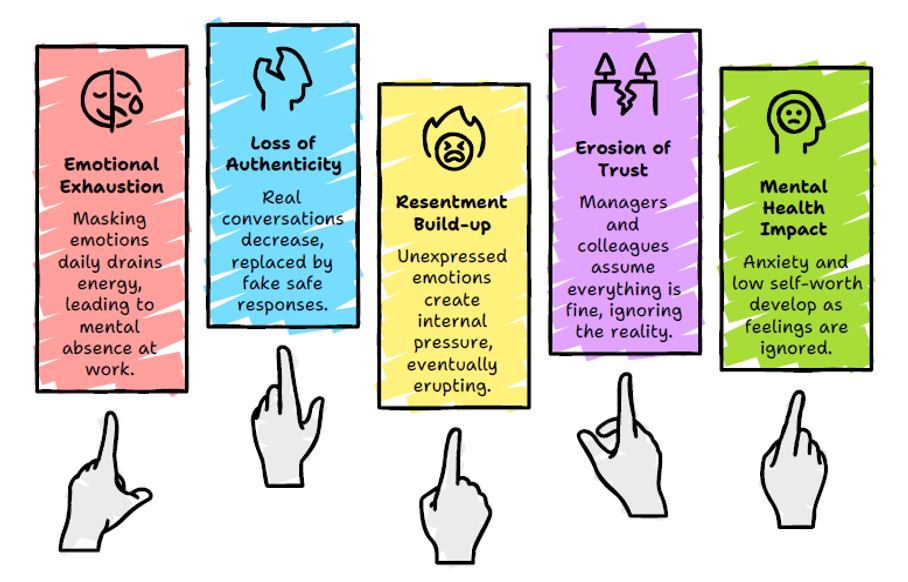
Impact of a False Smile
Lesson for HR & Leaders
- Employee generally smiles to look professional, that doesn’t always means everything is fine with them.
- HR should also focus to understand employees smile pattern and in case of any distress , support them for their well-being.
- HR and leaders should encourage their employees to share their concerns, to make workplace healthy and resilient. This will not be seen as weakness, rather as a sign of organizational maturity.
- HR and leaders can work as emotional anchor by listening to employee and showing proper method to help them fix the problem.
- To sustain long term Professionalism, HR and leaders should have empathy and humanity towards their employee, rather than treating them like machine or object.
- Simple questions, like : Was today’s workload manageable? Or If you need any support , please let us know, helps employee to trust on their HR and leaders and these small things signal care, approachability, and psychological safety, reducing the need of employee for emotional masking (fake smile)
Ask yourself:
- Do I smile with comfort or feel compulsion with it?
- When was the last time I told myself or someone close that I am not ok ?
- Am I hampering my boundaries, over adjusting as per other’s needs, or hiding my exhaustion behind my smile ?
- Does my smile and silence protects me or drains me due to self-neglect?
- If I smile less or don’t , will I become less professional?
Conclusion :
Smile is a powerful social tool, it provides comfort, confidence and connections. But when a smile becomes a tool for survival, it doesn’t distance us from others, but from ourselves.
With this blog, my purpose was not to criticise workplaces or dismiss professionalism as fake. But to make a new balance where respect is maintained while real feelings are also given space.
A healthy workplace is not a place where everyone shows fake smile but a place where one can work as a human being not as a machine.
If you found this helpful… Save this guide for later & share it with someone who might need this.
And I will meet you soon with my next blog. Till then… Bye & take care.
1 Comment
Rajyshree Joshi · January 22, 2026 at 9:56 am
Interesting read