Introduction to Body Language and Why It Matters in Professional Success
In today’s professional world, your body language is as important as your words. They say: Your body speaks before your words do. It shows professionalism and confidence you carry. People start forming perceptions about you the moment they notice your body language, like your gestures, expressions, posture, even your eye contact.
What is Body language?
Body language can be defined as non-verbal communication through which we express our feeling and thoughts without saying anything. This happens through body gestures, facial expressions, posture, hand movements & eye contact. When we talk with someone, our gestures, postures, facial expressions, hand movement and eye contact commute most of the thing about us, like our mood, our personality, our confidence, etc.
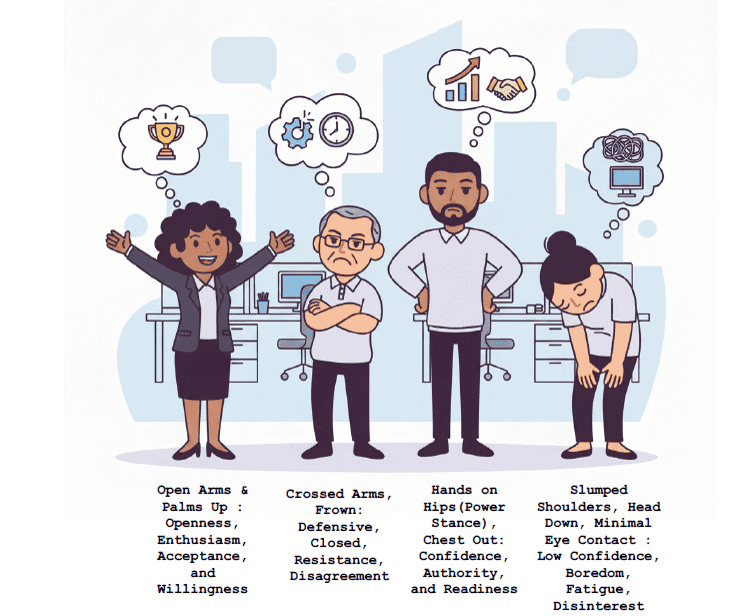
Body Language is the most natural and powerful part of our communication, as most of the times our actions speaks louder than our words.
In communication , role of words are important, but as per research, 60-70% of the impact in conversation comes from our body language.
For example: Showing a genuine smile is a symbol of confidence but crossed arms symbolize defensive and uninterested behavior. Also, eye contact symbolize honesty and avoiding eye contact symbolize insecurity and hesitation.
Body language is an unconscious process and are direct reflection of our emotions. Like if we are happy, we automatically smiles but when we are in tension or in stress, our shoulder tightens up.
Types of Body Language
There are many types of Body language, let’s explore them one by one:
Facial Expressions : Our face acts like an open book, telling others what we feel. This happens because expressions in our face are the strongest. The way we smile, frown, raised eyebrows, bite our lips, indicates our mood, personality and tells whether we are friendly, curious or confused at the moment.
Facial expression reinforce ones word to enhance professional credibility of an individual.
For example: When you genuinely smile and nod during a project meeting, it shows that you are interested in the project and understanding what speaker wants to tell. This shows friendly & curious behavior resulting in positive environment among the team.
Eye contact: They say, what words can’t say, eyes convey them. Same logic also applies in professional communication. Eye contact help us to understand emotions and intentions of the person we are talking with.
When a person makes a proper eye contact, it shows that the person believes in him, is confident, sincere and interested in the work getting discussed or in what other person is sharing.
If someone starts staring at other, it shows signs of aggression and dominance. But when someone avoids eye contact, look down frequently, or get distracted easily, it shows signs of nervousness, unsure and dishonesty.
In simple, balanced eye contact creates trust and enhance communication among the people.
For example: During a client meeting, answering client with steady eye contact shows that person is honest & attentive and confident with the work. But avoiding the eye contact , give idea of nervousness and unsurely.
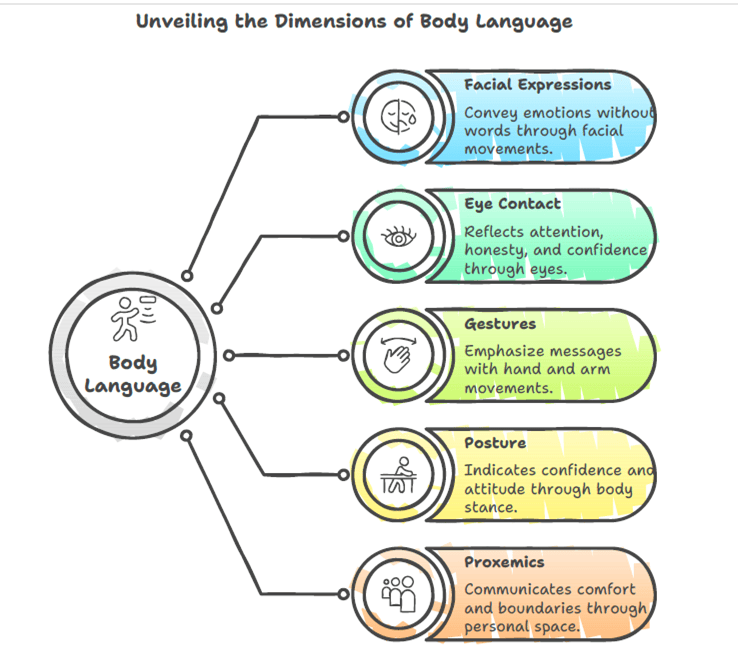
Gestures: It is another strong non-verbal signals which convey emotions and intentions of a person. This include movement of hands and arms, like handshakes, pointing, giving thumbs-up and leaving arms open during conversation.
Gesture make professional communication more interactive and engaging,. It also conveys emotional state of a person.
For example: Open palm during conversation and meetings shows trust and honesty whereas crossed arms shows defensive and closed attitude.
Posture: In Body language , posture like standing and sitting by a person plays an important role. It helps in identifying how person is feeling at the moment.
When a person is straight & in relaxed position, it symbolize confident, whereas slouching and hunched position shows low interest or low confidence within an individual.
Posture not only show confidence among person but also shows professionalism and body control.
For example : During an interview, candidate with low confidence , unconsciously slouch which creates a bad impact on interviewer, regardless of no. of perfect ans he provides. Resulting in losing the position he is taking interview for.
Proximity: Concept of Proximity or Personal Space is a part of Body language. This is used to defines our level of comfort and relationship with a person, by the distance we maintain with them while having a conversation.
In professional setting , it is important to choose comfortable distance and maintain personal distance with a person we are working with, like – colleagues, seniors, clients and our team members.
If we stand way too close with other person, then other person will get uncomfortable, but if we stand far away from them , they will feel that we are not interested in the conversation and lacks professionalism.
Maintaining a balance distance is a way to show our respect to another person and making them comfortable around us.
Proximity makes interpersonal relationships smoother and more professional. It increases trust and mutual respect between people.
For example: During a team meeting, every member is in their comfort zone. While during discussion, when we respect another person’s personal space, people consider us as an emotionally intelligent, but if we keep touching our colleague in back or in shoulder, or trying to get unnecessarily close with them , they may feel uncomfortable and this can result in negative work environment.
Conclusion: These 5 types of body language – Facial Expressions, Gestures, Posture, Eye Contact and Proximity, are crucial for professional success. They enhance confidence, trustworthiness and credibility of a person.
Body language is not only limited to professional life , it play similar role in personal life. When person works on their body language, like – maintaining open gestures, balanced eye contact, confident posture along with respectful personal space, they create positive impression of themselves, enhance career growth and professional relationship.
Importance of Body Language in Professional life
In professional world, our body language work like a Personal brand for us. This help us in career growth, networking and in leadership opportunities.
1) The most crucial – First impression matters: During job interviews, client meetings & in networking event, even in personal life, FIRST IMPRESSION MATTERS as body language speaks louder than our words. A firm confident handshake, smile and straight posture shows you as a confident individual with positive attitude.
2) Gives value to your communication: A balanced body language reinforce your verbal communication. People takes your ideas seriously, when they feel enthusiasm and engagement in our personality. But, if we show signs of distraction or boredom from our end, our word values declines.
3) Shows Leadership and Authority: Effective leaders inspires us with their strong and positive body language. Straight posture, firm handshakes and confident gestures enhances their credibility.
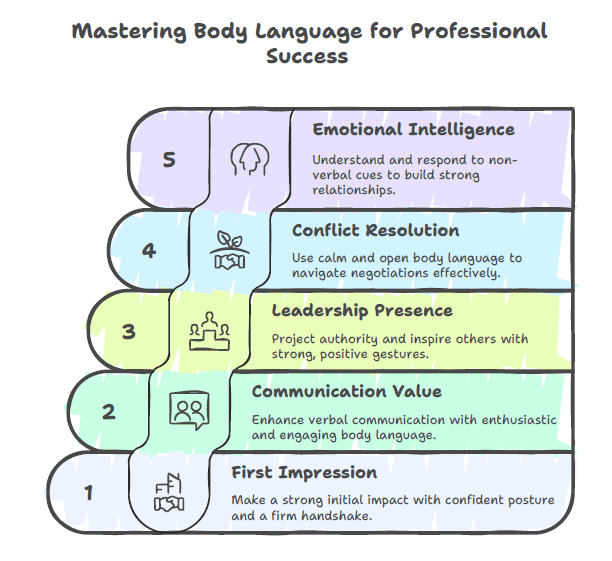
4) Conflict Resolution and Negotiation: During Conflict Resolution and Negotiation situations, our body language plays a crucial role as our posture, facial expression, tone, attitude help other person decide how they are going to perceive our intention toward the situation.
If we act calm and composed, other person perceive that we can handle the situation in stable way without being biased. Maintaining eye contact shows trust & sincerity toward the situation. Further open gestures (like open palm) makes communication non-defensive & positive.
Whereas, avoiding eye contact, keeping closed posture & frowning, makes communication – defensive or hostile, resulting in making negotiation tough .
5) Emotional Intelligence & Empathy: Body language is further used to express Emotional Intelligence & Empathy. It help us to understand non-verbal cues of a colleague, like stress or frustration they are showing through their body language, resulting in strong relations and professionalism among team members.
Steps to improve Body language:
- Practice Good Posture: Maintain straight and relaxed posture by keeping shoulders back.
- Maintain Open Gestures: Keep hands open while occasionally showing palms.
- Maintain Balanced Eye Contact: Avoid over staring & constantly avoiding of eye contact.
- Smile Often: Maintain genuine smile, to show warmth, respect and friendliness to others.
- Mirror Practice: Practice your gestures, posture & expression in front of mirror for 21 days to make it habit.
- Observe Others: Learn by observing other successful professional’s body language.
A Short Case Study:
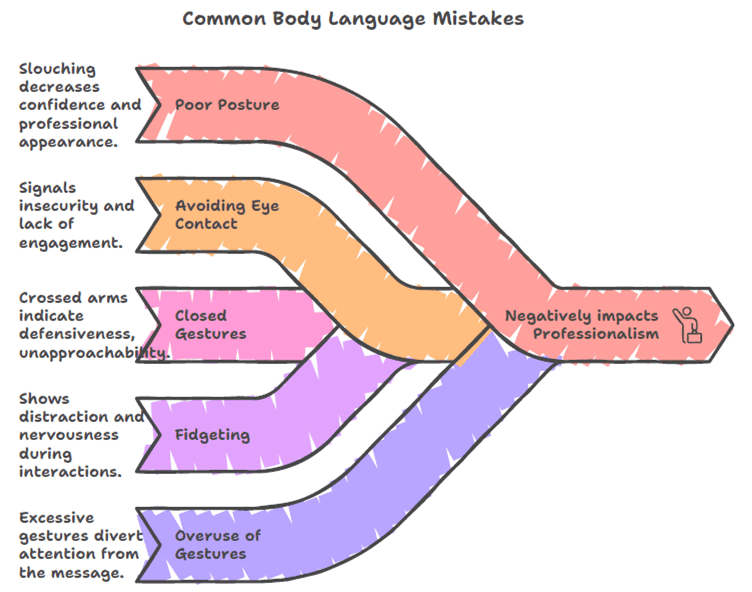
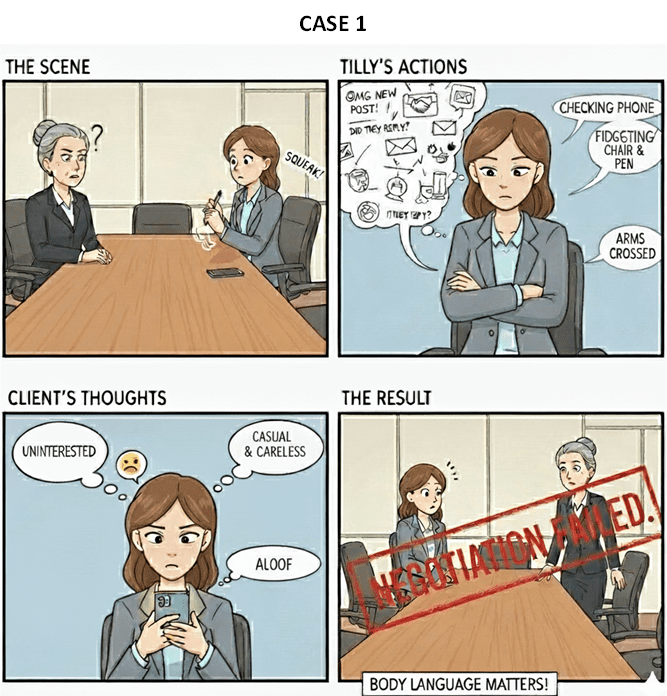
Case 1: Assume, Tilly (Assistant manager) went for a negotiation at client’s office. There she keeps on checking her phone, fidgeting with chair and pen nearby & sits with her arms crossed. What you think client will make from her body language?
Let’s understand this with image below:
Case 2: But if Tilly (Assistant manager) enter the meeting with straight and relaxed posture, have a firm handshake, balanced her eye contact and with controlled gestures, actively participate in negotiation with questions-answers. What you think client will make from her body language this time?
Let’s understand this with image below:
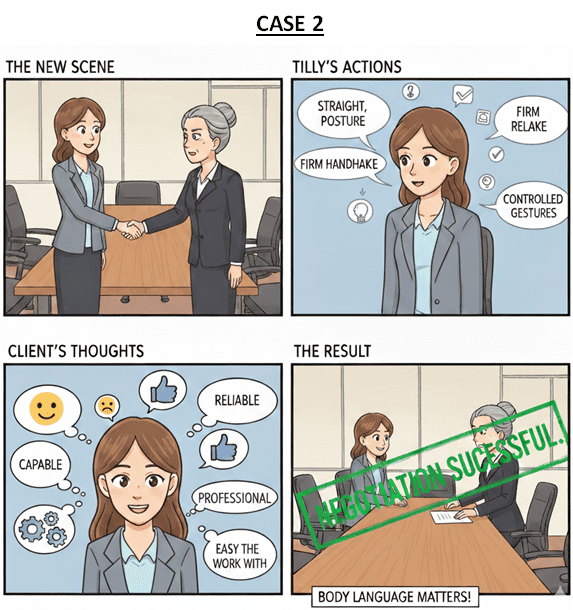
From this story , we can say that body language not only influence perception but also shapes career outcomes.
Body Language and Career Growth:
In professional life, strong and positive body language is very crucial for long term career growth. During networking events, presentations, client meetings and even in job interviews, calm and confident gestures, open postures and positive facial expressions conveys that a person is trustworthy and capable individual, who can inspire teams or group with their non-communication skills.
This confident and approachable behavior often gets highlighted, helping individuals earning high visibility projects with responsibilities, which helps individual in promotion and in leadership opportunities.
Career growth not only depends upon a person’s qualifications and skills, but also on how they present themselves in a professional environment.
Conclusion: In today’s competitive professional world, body language is more important than words, as people perceive what they see and feel, and their perception shapes the way they treat you.
With positive body language people will see your confidence, professionalism, credibility to others.
Finally, Body language is an integral part of our personal branding. If we constantly and consciously improve our body language, our professional & personal relationships and career goals will see a positive transformation, leading us to success.
I hope you like this 1st article. I am going to make a series in the same Topic: Body language. So stay connected.
I hope you will support me & guide me through this journey and I will see you all in my next article. Till then …. Take care and Bye.
7 Comments
Mohit · November 24, 2025 at 12:12 pm
Nice read.
K Kant · November 24, 2025 at 12:12 pm
Excellent work
Tashiyana Joshi · November 24, 2025 at 1:02 pm
Very insightful thoughts on the topic
Rajyshree Joshi · November 24, 2025 at 2:20 pm
Very helpful insights 🙏
Pradeep Upadhyay · November 24, 2025 at 2:43 pm
Keep it up
Padma Upadhyay · November 24, 2025 at 2:46 pm
Good
Pradeep Upadhyay · November 24, 2025 at 2:48 pm
Great keep it up