Interview Body Language: What Recruiters Notice Before You Speak
Think about this: You prepared all night for an interview. You studied every possible question, researched the company and even checked the interviewer’s profile.
But the moment you enter the interview room, within seven seconds, the recruiter has already formed a strong opinion about your reliability, trustworthiness, and competence, purely on the basis of your body language. Most candidates don’t even realise this at the moment.
And the most surprising part? All this happens before you answer even one question.
In this blog, we will explore what recruiters observe from your behaviour in the waiting area to your handshake, posture, eye contact, facial expressions, gestures, and voice tone. Let’s understand how these nonverbal cues influence hiring decisions and how you can use them to your advantage.
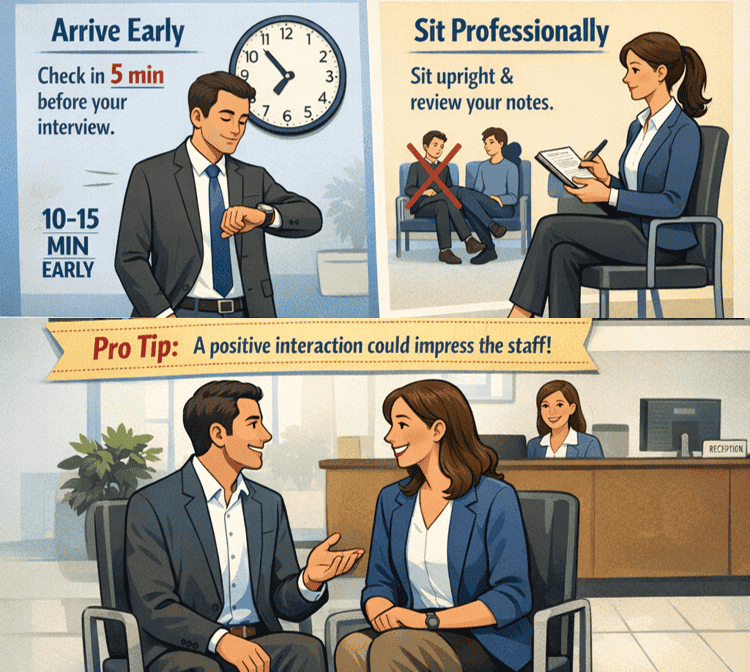
1) Waiting Area: The Place Where the Interview Actually Begins: Many candidates believe that the interview starts when they enter the interviewer’s room. In reality, the interview begins the moment you enter the company building. The receptionist, security guard, or even a random employee you meet can be a potential observer.
In many organisations, recruiters deliberately ask reception staff about a candidate’s behaviour and attitude.
Direct and indirect cues recruiters may notice while a candidate is in the waiting area include:
- Was the candidate waiting professionally with their phone kept aside, or were they scrolling continuously on social media?
- Did they speak politely and respectfully with the receptionist or support staff?
- Did they appear restless: repeatedly checking the time, shaking their legs, or touching their hair? Or did they seem calm, composed, and grounded?
It is completely normal to feel anxious before and during an interview. However, when anxiety becomes visible through body language, it can weaken the recruiter’s initial perception of the candidate.
Therefore, the first step in an interview is to manage your anxiety and present yourself as calm, composed, and confident through your body language from the very beginning.
Smart moves in the Waiting area:
2) Entry and Handshake: When a candidate enters the interview room, he communicate so much within few minute with his body language. Psychologists call this “thin-slicing”, where the recruiter’s brain rapidly forms a judgment based on very little information. This judgment is often surprisingly accurate and quite deep, which makes it difficult to change later.
Entry Tips: When Entering the Interview Room:
- Enter with a purposeful stride.
- Don’t walk too fast or too slow. Maintain a steady pace.
- Keep your spine straight, shoulders slightly back, and head raised. This posture signals confidence and professionalism.
- As you enter, make eye contact with the interviewer.
- Offer a genuine, warm smile.
- Greet with a firm & professional handshake.
Handshake: is more than a social formality. Research shows it helps people form first impressions and conveys a tremendous amount of information. A study by the University of Alabama found that a handshake can accurately predict personality traits such as extraversion and emotional stability.
A balanced, firm handshake often conveys confidence and professionalism, whereas a weak, overly dominant, or hesitant handshake may trigger negative subconscious impressions.
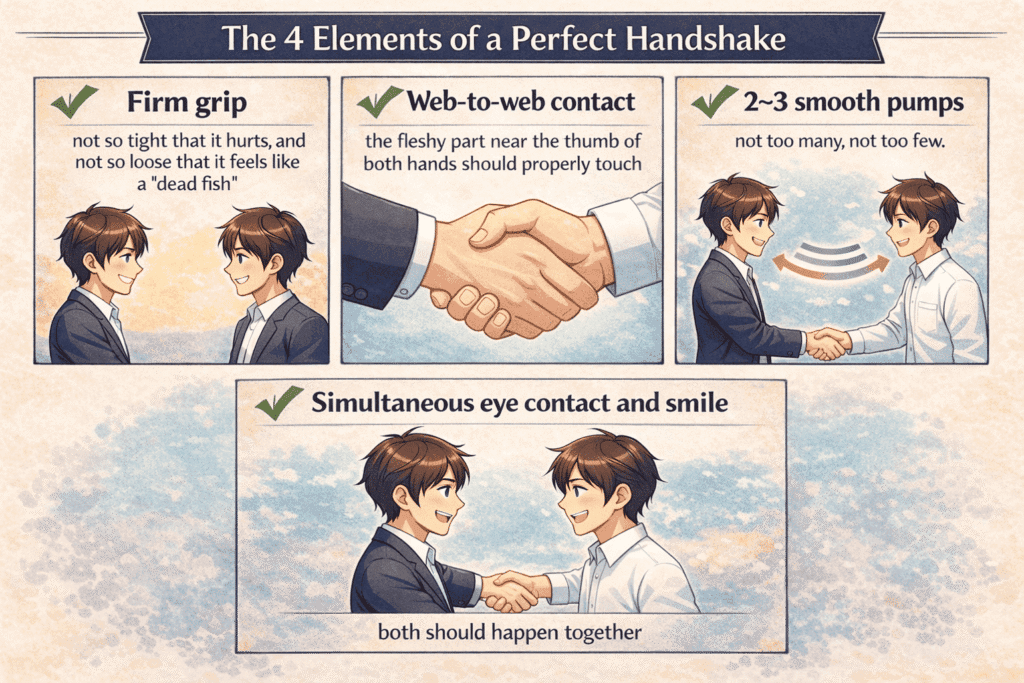
Quick Practice Tip: Practice your handshake with friends or in front of a mirror. Focus on grip, eye contact, and a natural smile. This builds muscle memory and reduces anxiety during real interviews.
3) Posture: The moment you sit on the interview chair, your posture starts conveying real-time indicator of your confidence level, engagement, and energy. Recruiters consciously or unconsciously read many signals from your posture.
Confident Interview Posture: Maintain an open and engaged posture:
- Sit upright, slightly away from the back of the chair.
- Keep both feet flat on the floor.
- Place your hands in a visible and relaxed position on the table or in your lap.
- Lean slightly toward the interviewer to show interest and involvement.
- This posture signals confidence, attentiveness, and professionalism.
Avoid these negative posture signals:
- Crossing your arms, which appears defensive or guarded.
- Leaning completely back, which may signal disinterest or arrogance.
- Crossing one leg and shaking it restlessly, which shows anxiety or nervousness.
- Leaning too far forward and invading personal space.
- Any restless or fidgeting movements that reduce your perceived confidence.
4) Eye Contact: is a balancing act. Too little makes you appear evasive, dishonest, or low in confidence. Too much can feel aggressive, strange, or uncomfortable. There is a “sweet spot” that recruiters consciously or unconsciously sense.
Ideal Eye Contact Formula: During the overall interview, maintaining eye contact for approximately 60–70% of the time is ideal. When you are actively listening, your eye contact should be higher around 80%. When you are speaking, it can be slightly lower around 50–60%, because people naturally look away while thinking, and that is completely normal.
In case of a panel interview, your eye contact strategy should change accordingly:
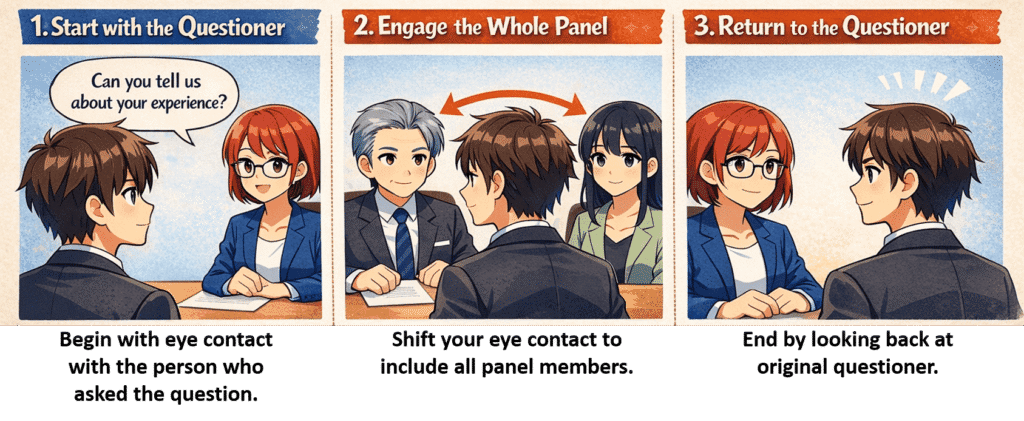
When you are thinking, looking to the side is fine. However, repeatedly looking down, toward the floor or your lap, signals avoidance and low confidence.
5) The Language of Hands: Hand gestures are a very important but often considered as overlooked dimension of communication. Research by Science of People found that when speakers use their hands while talking, they appear more engaging, passionate, and credible.
In analyses of TED Talks, the most viral speakers were found to use a higher number of gestures. On average, speakers used about 272 gestures in 18 minutes, while top speakers used almost double.
Positive Gestures That Impress Recruiters:
- Open palms: Show your hands while speaking. It makes you look honest and confident.
- Counting on fingers: Use your fingers to explain points. It shows clear and organized thinking.
- Explain with hands: Use simple gestures to describe ideas. This makes you look engaged and passionate.
- Steepling: Join your fingertips sometimes. It signals confidence. Don’t overuse it.
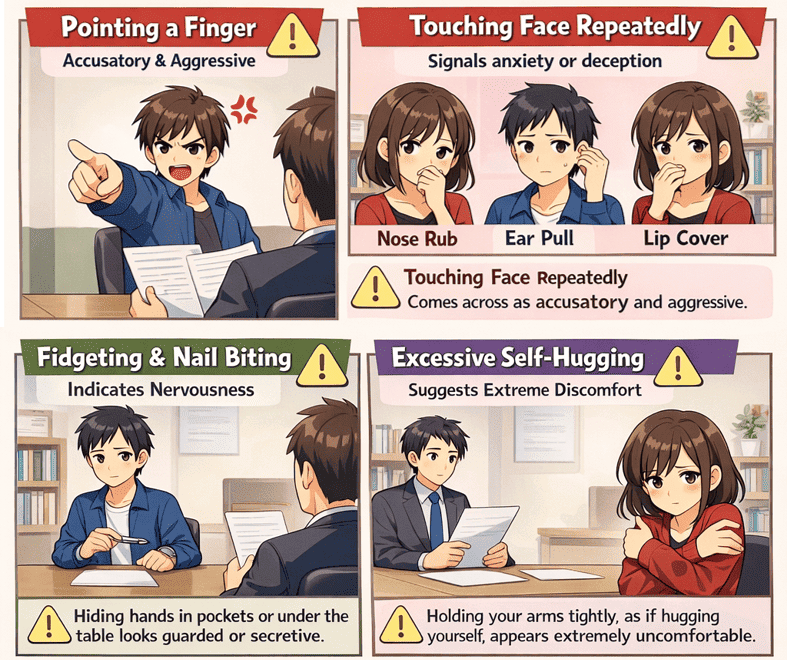
Avoid these negative Gestures signals:
6) Facial Expressions: Dr. Paul Ekman’s research shows that certain facial expressions are universal across cultures: happiness, sadness, anger, fear, surprise and disgust.
These expressions appear on the face for only 1/25th of a second and are known as micro-expressions. Experienced recruiters and increasingly, AI-based assessment tools, can detect these signals.
Genuine Smile vs. Social Smile: A genuine smile, known as a Duchenne smile, does not come only from the lips but also from the eyes. Wrinkles appear at the corners of the eyes (often called “crow’s feet”), and the cheeks lift slightly.
A social or forced smile, on the other hand, involves only the mouth muscles. Visually, the difference is subtle but real, and the human brain intuitively distinguishes between the two. Even if recruiters are not consciously aware of it, their gut feeling is influenced by this difference.
Visual Markers of Genuine Enthusiasm
- Slight eyebrow lift
- Open and engaged facial expression
- Natural eye involvement
- Warm, relaxed smile
7) The Power of Paraverbals: Body language is not only about visual. The way you use your voice: tone, pitch, speed, volume, and pauses, together forms paraverbals.
Research often suggests that in communication, only about 7% of meaning comes from words, 38% from voice tone, and 55% from body language. These exact numbers are debated, but one thing is clear: how you say something matters as much as what you say.
Speaking Speed matters a lot as speaking too fast is one of the most obvious signs of anxiety and nervousness. When you talk faster than your brain can process, sentences become incomplete, filler words increase, and it becomes difficult for the listener to follow.
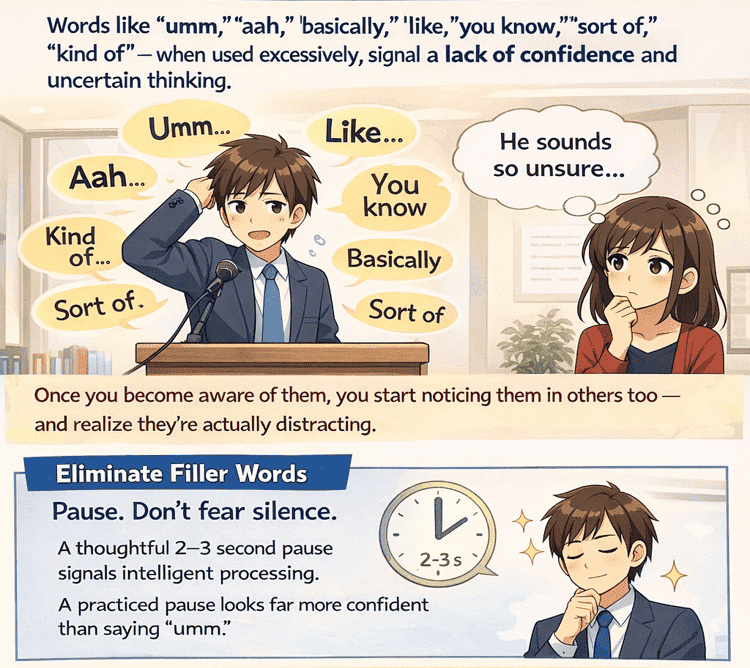
On the other hand, speaking too slowly can signal boredom, low energy, or difficulty in communication.
A medium, measured pace that sounds deliberate and purposeful is the strongest vocal signal of confidence and clarity.
If you are naturally a fast speaker, consciously slow down. A simple and effective trick is to take a brief pause after every sentence.
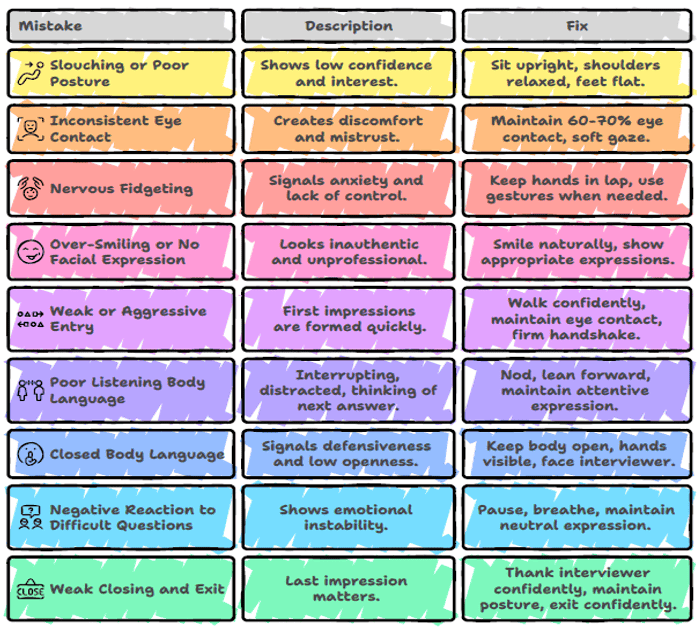
Common Body Language Mistakes
The Final Interview Impression: Your Exit Matters Just as Much
As per the Recency effect, the final few minutes of your interview and your exit are just as important as your entry. Many candidates start feeling mentally “done” toward the end. Their posture drops, energy decreases, and engagement fades. This is a mistake.
Closing the Interview: Your Final Impression
1) A Genuine Thank You
- Avoid generic phrases like “Thank you for your time.”
- Give a specific and sincere appreciation.
- Mention something meaningful from the conversation to show active listening and emotional intelligence.
2) The Questions You Ask
- Lean slightly forward and maintain an engaged expression.
- Ask thoughtful and relevant follow-up questions.
- Take brief notes if appropriate, it shows preparation and seriousness.
3) The Confident Exit
- Offer a warm closing handshake if suitable.
- Maintain eye contact and a natural smile.
- Walk confidently until you are completely out of sight.
- Stay professional until the very end.
4) Follow-Up: The 24-Hour Rule
- Send a professional thank-you email within 24 hours.
- Mention one specific insight from the interview.
- This reinforces professionalism and emotional intelligence.
Conclusion: Interview preparation is not just about answering technical questions. It is a holistic process that requires self-awareness, emotional control, and conscious body language.
To build this, candidates must work on these along with technical skills:
- Self-awareness
- Self-regulation
- Empathy
- Motivation
- Social skills
Further, candidate should practice nonverbal communication: facial expressions, eye contact, gestures, posture, and vocal delivery.
Always remember, the recruiter is also a human being. They are looking for someone who is genuine, self-aware, emotionally grounded, and capable of staying composed in challenging situations while contributing to long-term growth.
So the next time you enter an interview room, stand tall, smile warmly, offer a confident handshake, and walk in with purpose.
You have prepared your answers. Now let your body language reflect your confidence and authenticity.
All the best for your interview!
2 Comments
Pradeep Upadhyay · February 28, 2026 at 10:15 am
बहुत बेहतरीन और प्रेरणादायक है।
K Kant · February 28, 2026 at 11:50 am
Excellent work