The Fascinating Science of Proxemics: 4 Powerful Personal Space Zones
PROXEMICS SERIES · POST 2 OF 3
Your brain reacts more strongly to an unexpected physical intrusion than to most verbal interruptions. A word can be ignored. A body standing too close cannot.
In Post 1, we established the foundation:proxemics is the silent language of space, shaping workplace interactions before a single word is spoken. Now we go deeper into the neuroscience of why your body reacts the way it does, the cultural differences that make the same distance feel warm to one person and threatening to another, and the technologies that are quietly rewriting the spatial rules humans have developed over millennia.
Picture stepping into a nearly empty elevator. The doors close, then a stranger enters and, despite plenty of available space, stops directly beside you. No word is spoken. Yet your body reacts before your conscious mind has processed what happened: your shoulders tighten, your jaw sets, and your eyes fix forward. That wordless alarm is not simply social awkwardness. It is a neurological response, a primal signal firing in a brain shaped by a world where an undetected approach from close range could mean danger.
In the 1960s, anthropologist Edward T. Hall coined the term proxemics to describe how people use and interpret space as a form of communication. In The Hidden Dimension (1966), he argued that space is not empty air, but a language we speak fluently long before we understand its rules.
Research has since shown that Hall was describing something deeper than social convention. The same neural systems that monitor personal space in a crowded elevator also respond when an avatar stands too close in virtual reality or when a face fills a video-call screen. Personal space is not merely cultural. It is biological, psychological, and increasingly technological.
This is the invisible architecture of human life. And in an era of urban density, post-pandemic behavioral shifts, and accelerating digital immersion, it is under more pressure than ever. Understanding it is not academic. It is one of the most practical things you can know about being human.
Proxemics and the Four Zones of Personal Space
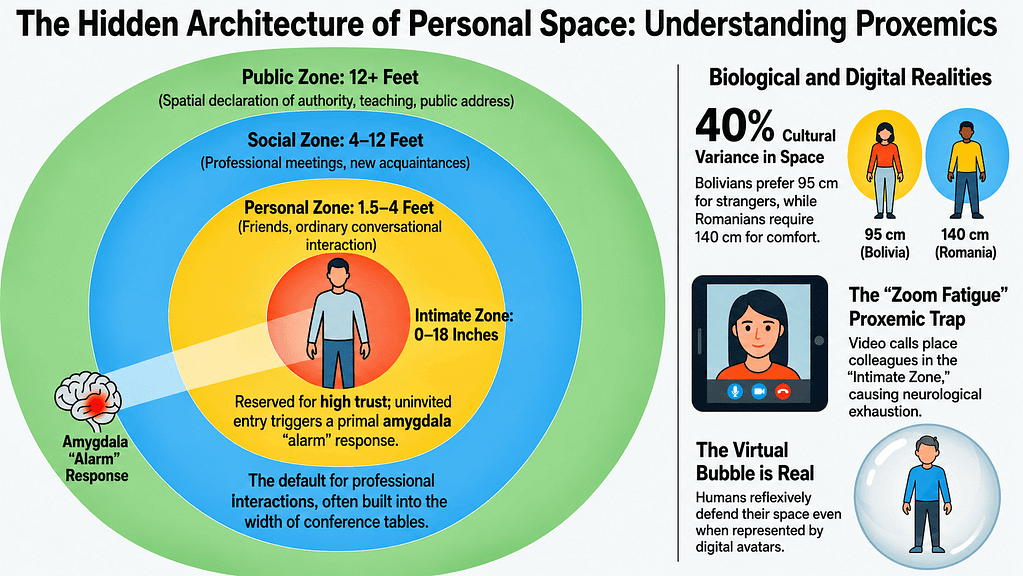
Hall identified four concentric zones of interpersonal distance, each calibrated to a specific level of trust and social function. These are not rigid measurements but culturally shaped ranges, the distances at which particular types of interaction feel natural and beyond which they begin to feel wrong in ways that are difficult to articulate but impossible to ignore.
Proxemics Zone 1: The Intimate Zone (0-18 Inches)
This innermost ring belongs to the people we trust most: romantic partners, close family, and dear friends. At this distance, every sense is activated, including body heat, scent, whispered speech, and the warmth of touch. Invited entry triggers the release of oxytocin, the neuropeptide central to social bonding (Feldman, 2017). Uninvited entry triggers the opposite: amygdala activation, cortisol release, and a physiological readiness to withdraw. The brain, famously, does not distinguish between a socially oblivious stranger and a physical threat. The alarm response is identical.
Proxemics Zone 2: The Personal Zone (1.5-4 Feet)
The zone of friends and family in ordinary interaction, such as a dinner conversation, a side-by-side walk, or a shared confidence. It preserves warmth without the stakes of full intimacy, and it is the primary arena where nonverbal communication becomes legible: the micro-expressions, the lean of the body, the direction of a person’s feet all resolve into readable signals at this range. In both romantic and professional contexts, a deliberate, gradual move into this zone is one of the most reliable nonverbal signals of growing interest and trust.
Proxemics Zone 3: The Social Zone (4-12 Feet)
The default distance of professional interaction, such as a manager with their team, a client meeting, or a new acquaintance at a gathering. It sustains engagement without demanding personal closeness. This zone is literally built into the furniture of modern professional life: a standard office desk positions visitors at four to five feet; a conference table creates seven to ten feet across its width. These are not arbitrary choices. They are proxemics technologies that use distance to calibrate formality, hierarchy, and the terms of an encounter before a single word is exchanged.
Proxemics Zone 4: The Public Zone (12 Feet and Beyond)
Beyond twelve feet lies the domain of public address, including classrooms, boardrooms, stages, and podiums. At this distance, the nuances of personal interaction give way to amplified, deliberate performance. Gestures broaden. Voice is projected. Eye contact becomes a technique of audience engagement rather than reciprocal exchange. The Public Zone is a spatial declaration of authority, and those who occupy it skilfully understand that the distance itself carries meaning before the speech begins.
When the Brain Stops Drawing Boundaries
In 2009, neuroscientists at the California Institute of Technology published what would become one of the most influential studies in proxemics research. Their subject was a woman known as S.M., who had a rare genetic condition that destroyed both of her amygdalae, the brain structures central to threat detection and fear processing.
Researchers wondered whether a person who could not experience fear would also regulate personal space differently. They asked S.M. to approach a member of the research team and stop at whatever distance felt comfortable.
Most people stop at roughly two feet, close enough to be friendly but not intimate.
S.M. stopped within half an inch.
She reported no discomfort. In fact, she said being that close felt more natural.
The study’s conclusion, published in Nature Neuroscience (Kennedy et al., 2009), was striking: the amygdala is not merely involved in fear. It plays a critical role in regulating personal space. Without it, the felt sense of a boundary largely disappears.
Most of us experience personal-space violations as a vague discomfort when someone stands too close. S.M.’s case revealed that this feeling is not simply social conditioning. It is a neurological process running beneath conscious awareness.
This is the system that activates when someone stands too close in an elevator. Not manners. Not social convention. A neural system, older than language itself, constantly monitoring what is nearest.
Key Insight: Personal space is not a social preference you can override with politeness. It is a neurological state, enforced by specific brain systems that activate independently of conscious decision-making. Respecting it is not merely courtesy. It is biology.
The Global Map of Distance: Culture and the Spatial Divide
If personal space were purely biological, all humans would maintain roughly the same distances. The fact that they don’t, and that a conversational gap that feels comfortable in Buenos Aires may feel intrusive in Helsinki, reveals the powerful role culture plays in shaping our spatial expectations.
Cross-cultural psychologists distinguish broadly between contact cultures, where closer distances and physical touch are common, and non-contact cultures, where greater distance signals respect. What feels warm and engaged in one culture can feel unexpectedly intense in another.
These differences create what Edward Hall described as the spatial dance. In one of his most famous examples, two Venezuelan students speaking with a North American woman found themselves in an unconscious choreography. They stepped forward to close what felt like an awkward distance; she stepped back to restore what felt like comfortable space. Neither intended to create discomfort. Each was simply following a different cultural script.
Large-scale research confirms that these differences are measurable. A 2017 study by Sorokowska and colleagues, involving more than 8,000 participants across 42 countries, found that preferred interpersonal distances varied by as much as 40% between cultures. A comfortable conversational distance with a stranger was approximately 95 centimetres for participants in Bolivia and closer to 140 centimetres for participants in Romania.
Same species. Same social intent. Nearly half a meter of difference.
In international business, leadership, healthcare, and diplomacy, that gap matters. The distance that communicates warmth to one person may communicate intrusion to another. Understanding proxemics therefore requires more than understanding human biology. It requires understanding the cultural lens through which that biology is expressed.
The Great Paradox: Built for Closeness, Rewarded for Distance
Human beings evolved for physical proximity. The neurochemistry of social bonding, including oxytocin, endorphins, and the calming effects of affiliative touch, is activated by closeness. Evidence that physical connection supports immune function, reduces cardiovascular risk, and contributes to longevity is substantial (Holt-Lunstad et al., 2008). At the most fundamental biological level, we are social animals that need to be near one another.
Yet the defining trend of the 21st century has been the systematic replacement of physical proximity with mediated distance. We send messages instead of visiting. We attend meetings on screens instead of in rooms. We maintain relationships across thousands of miles with an immediacy that feels like presence but lacks the neurochemical benefits of actual co-presence. We have built a civilization that is, in many ways, optimized for distance, and we are now beginning to observe the consequences.
Loneliness has emerged as a major public-health concern across much of the developed world. In 2023, the U.S. Surgeon General issued a formal advisory warning of its widespread effects, while decades of research have linked chronic social isolation to significant health risks. These findings have led researchers to ask an increasingly important question: are we creating environments so spatially and socially impoverished that they fail to provide the forms of connection human beings evolved to expect?
This is not a nostalgic argument for less technology. It is an observation about design. The question is not whether we use screens, platforms, and virtual spaces. We do, and we will increasingly. The question is whether we design those environments with any awareness of the proxemics and neurochemical needs they are replacing, or whether we simply optimize for convenience and scale and accept the biological deficits as an acceptable cost.
Zoom Fatigue: A Proxemics Diagnosis
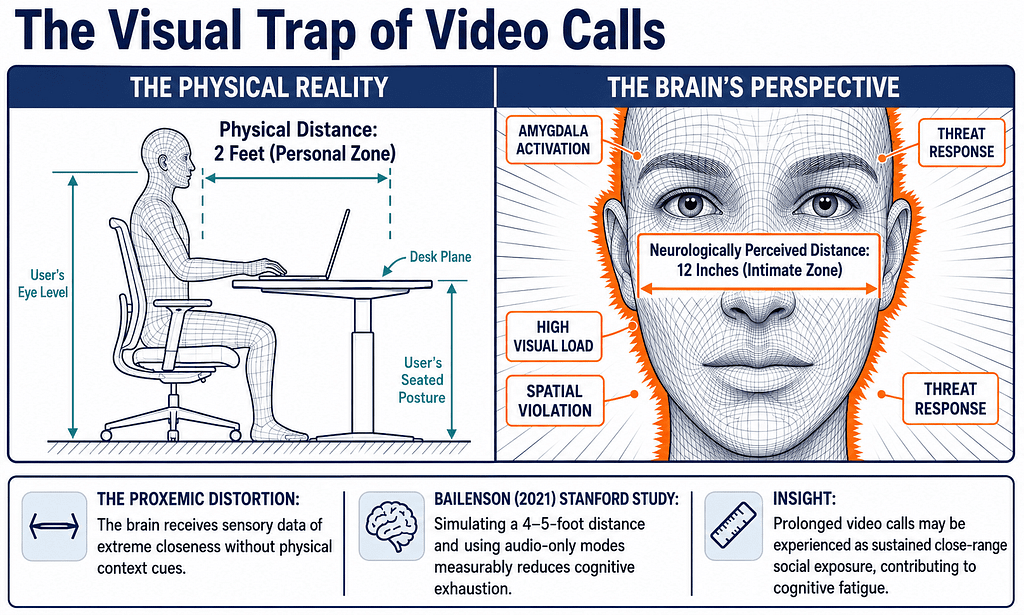
When a colleague’s face fills a laptop screen, the apparent visual distance places them well within what would, in physical space, constitute the Intimate Zone. The brain receives cues associated with extreme closeness, a large face, sustainedeye contact, and visible micro expressions, without any of the contextual signals that normally accompany such proximity: shared physical space,body language below the shoulders, and the subtle, constantly negotiated dance of distance that characterizes real-world interaction.
A landmark 2021 study by Jeremy Bailenson at Stanford University identified this proxemics distortion as a central contributor to Zoom fatigue. Participants experienced significantly lower fatigue when cameras were configured to simulate a Social Zone distance of roughly four to five feet, and when occasional audio-only modes reduced the burden of sustained close-up eye contact.
The implication is striking. Video conferencing tools did not simply digitize meetings, they unintentionally altered the spatial conditions under which those meetings occur. For hours at a time, our brains are asked to process interactions that resemble intimate-range encounters without any of the emotional and environmental context that normally makes such closeness comfortable.
In effect, many video calls place us in a state of prolonged proxemics contradiction: physically alone, yet neurologically surrounded.
No wonder it feels exhausting.
Spatial Intelligence: Practical Applications
Understanding proxemics is not merely an academic exercise. Every day, people make judgments about trust, authority, empathy, and connection based partly on how space is used. While these signals often operate below conscious awareness, they can have a measurable impact on professional and personal interactions.
Leadership and Negotiation
The arrangement of people within a room influences the tone of an interaction before a single word is spoken. Side-by-side or collaborative seating often encourages a sense of partnership, while greater distance or confrontational positioning can reinforce formality and separation. Effective leaders and negotiators pay attention not only to what is being discussed, but also to the spatial conditions under which discussion takes place.
Distance itself communicates intent. Remaining within an appropriate Social Zone signals professionalism and respect, while carefully reducing distance at key moments can foster trust and engagement without crossing personal boundaries. In this sense, the shape of a room and the positioning of its occupants become part of the conversation.
Healthcare and Human Care
Few professions demonstrate the importance of proxemics more clearly than healthcare. Research consistently shows that patients perceive clinicians as more empathetic when they sit rather than stand, position themselves at eye level, and reduce unnecessary physical distance during emotionally significant conversations.
These behaviors communicate presence, attention, and care in ways that words alone often cannot. In settings such as palliative care, pediatrics, mental health, and counseling, the effective use of space is not merely a communication skill, it is an essential component of compassionate practice.
Three Signals Worth Noticing
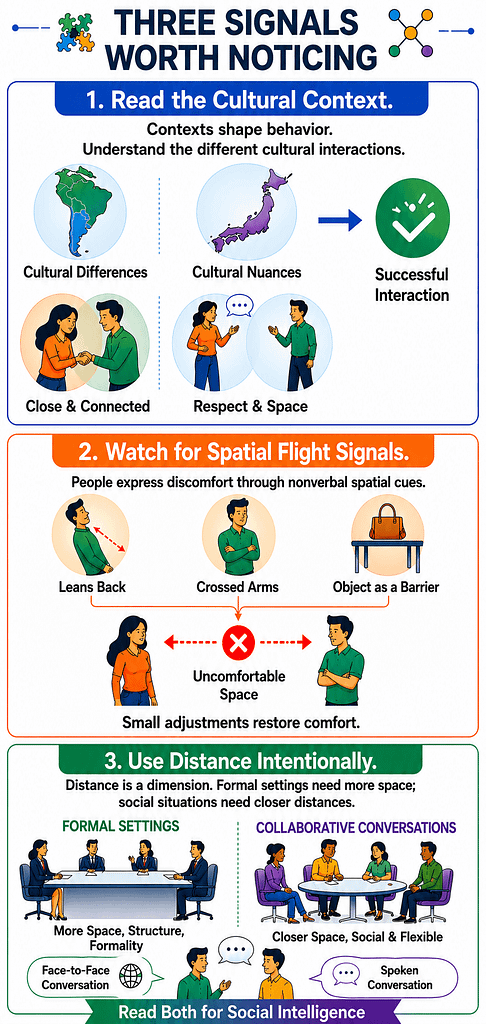
Understanding proxemics is not simply about knowing the four zones of personal space. It is about recognizing the subtle spatial cues that shape comfort, trust, and connection in everyday interactions. The most socially intelligent people learn to read these signals, adjusting distance, interpreting nonverbal feedback, and adapting to cultural expectations before misunderstandings arise.
Making the Invisible Visible
Some of the most provocative recent work in proxemics imagines making our spatial dynamics literally perceptible. Experimental installations in public spaces have used motion-sensing technology to render each person’s proxemics zone as a luminous, shifting volume, expanding, contracting, and overlapping as people move and interact. What these experiments reveal is that a complex negotiation is always taking place in the space between people, even when none of us consciously notice it.
The deeper lesson extends beyond technology. Personal space is not merely a social convention but a living system of signals that continuously shapes comfort, trust, attention, and behavior. Most of the time, we navigate this invisible choreography automatically, responding to spatial cues without ever realizing we are doing so.
Hall’s enduring insight was that space is not empty. It is information. The first step toward understanding its influence is learning to see what has been there all along.
Two Architectures
Over the course of this article, we’ve explored how personal space influences comfort, trust, culture, communication, and even the design of digital experiences. Taken together, these insights point toward a larger truth: every room you enter contains two architectures, the visible one, made of walls, furniture, and light; and the invisible one, made of personal space, social distance, and the silent agreements we make about how close is close enough.
Most people move through life noticing only the first. They rearrange the furniture. They repaint the walls. They rarely consider the second, even though it shapes every relationship, every negotiation, and every moment of connection or discomfort they will ever experience.
Hall’s great insight was that this invisible architecture is not random. It is structured. It is learnable. And it is far more malleable than most people realize, continuously shaped by culture, technology, trauma, and design in ways that are measurable, consequential, and unfolding all around us.
We evolved for proximity. Our brains continuously monitor, defend, and negotiate the space between ourselves and others, often without conscious awareness. Yet modern life increasingly asks us to communicate across distance, replacing many moments of physical co-presence with digital connection. The convenience is undeniable, but it has also revealed something important: not everything that matters in human interaction travels across a screen.
This is not an argument for turning back. It is an argument for paying attention. The next time you feel the reflexive tension of someone standing too close or notice yourself reaching for your phone in a crowded elevator, or finishing a day of video calls more exhausted than expected remember that your spatial intelligence is already at work. It has been quietly guiding your behavior for your entire life.
The question is not whether to listen to it. You already do. The question is whether, finally, to understand it.
Thank You!


1 Comment
Body Language in Workplace: 5 Mistakes & 6 Career Tips · August 13, 2026 at 3:34 am
[…] Understanding Proxemics in the Workplace: Powerful Personal Space InsightsThe Fascinating Science of Proxemics: 4 Powerful Personal Space Zones […]