Facial Expression : Superstar of Body Language
In our last blog, we discussed about Body Language & its types. How it acts as silent communication. How Body Language act together with words to communicate information and what role it play in our professional life.
As we know, Body language consist of 5 types :
- Facial expression
- Gestures
- Postures
- Eye contacts
- Proximity
But if you will ask me: Which is the most powerful signal. I will say : “Facial expression”.
Why : Because our face reveals the truth within 0.2 sec. It reacts before words come out from our mouth & reflect emotions directly.
So, let’s begin this exciting journey:
What are Facial expression?
Facial expressions are those signals which person uses to show their emotions through their face.
Have you ever noticed – When we smile, our cheeks automatically lifts up. When we are afraid, our eyes widen up. When we are angry, our eyebrow tenses up. These happen unconsciously & automatically. These are real and natural signals which make facial expressions so authentic.
A person can control his words, his body postures. But facial expressions – No.
Face is direct output of one’s emotions. That means – when you feel certain emotions (like sadness, anger), they get activated at limbic system of your brain, which sent signals to face muscles, creating expressions.
Limbic system is also referred as Emotion machine or emotional control center of the brain. This system decides: when you will feel fear, anger, happiness, sadness & stress, this leads to expressions like heavy eyes, wide eyes & tight jaw. This system gives instant reaction of your emotions. Person have no control over this system thus no control over facial expression.
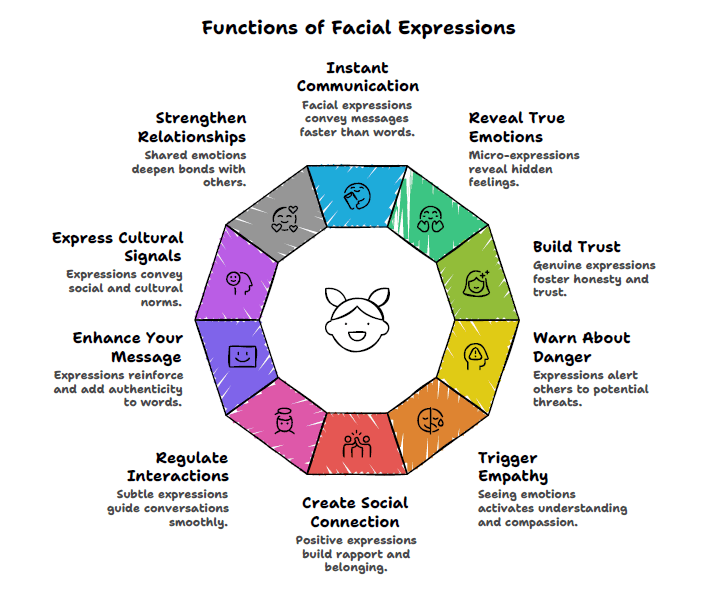
Why facial expression are so powerful?
- Your face sends emotional signal to receiver’s brain within 0.2 seconds. That means receiver can understand whether you are happy, angry or irritated just by looking at your face.
- Facial expressions of a person acts as behavior influencer, as it can change behavior of others. If you genuinely smile for a person, other person will feel relaxed and will give you friendly response. If you express tight jaw with clenched teeth to someone, the person will go on defensive mode.
- Human world revolves around faces because face have emotions. And emotions makes connection. People feel more satisfied with voice or video calls but feel disconnected in text messages as they can see facial expressions and hear tone of other person on voice and video calls which isn’t possible in text messages.
- Facial expressions are said to be universal all over the world, that means – whether you are in India, Kenya, or in Sweden, you will smile when you are happy, frown when you are angry, raise your eyebrows when got surprised & wrinkle your nose while feeling disgust.
Hidden Science Behind the Universal Language of Emotions
Secret for universal language of emotions is encoded within our brain and our biology. When we feel any emotions, like – sadness, anger, our brain automatically signals our facial muscles to move accordingly. We can call this process neurological syncing. That means both emotions and facial expressions are controlled by limbic system, that’s why, every country, culture and generation can naturally understand them.
As per Psychologist Paul Ekman’s research : Regardless of culture, language and geography, some emotions are universal, anywhere we go.
So we can say, Facial expressions are the closest thing we have for a global emotional language.
He further declared 6 emotions as Universal Basic Emotions, which are:
- Happiness
- Sadness
- Anger
- Fear
- Surprise
- Disgust
These are often called : Fingerprint of emotions. As whether you go anywhere, these emotions will gives same facial expression. These expressions are not learned, these are genetically wires which means, we are born with them.
Further, Facial expressions create emotional contagion, which means it transfer emotions to other person. You might have noticed, when someone is laughing , you also starts laughing with them. That’s because your brain neurons mirror facial expression and emotions of other person, leading to emotional contagion.
These mirror neurons makes us empathic and make nonverbal communication effortless.
6 universal emotions
For each of them, we will make separate blogs but here, let’s take a look on the surface:
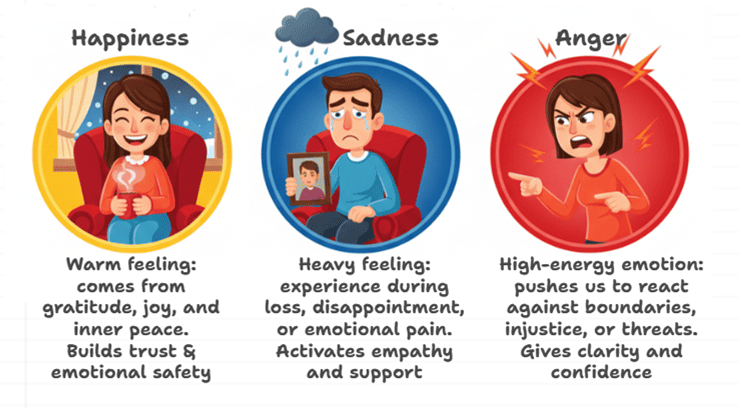
Happiness: is a feeling of warmth, comes from gratitude, joy and inner peace. It doesn’t comes just by smiling but from small things like: being with someone close to you, succeeding through hard work, hearing a good news.
Most importantly , it doesn’t come from perfect life, it comes from perfect mindset.
Sadness: is a heavy feeling that comes from loss, disappointment or from emotional pain. Sadness is natural and shows that we do care. Sadness makes us slow but plays important part in healing. When we accept our feelings, talk with someone we trust and give us time to understand and accept reason for sadness, it gradually lighten with time.
Sadness is temporary , not permanent.
Anger: is a strong emotion which generally happens when we feel something is unfair, unjust, hurtful and irritating. When anger is expressed effectively, it sets boundaries, further it helps during solving a problem and facing an injustice. Anger is a threat signal. It instantly alert others about the dangerous situations.
Anger is not a bad emotion, uncontrolled anger is. With proper channeling, it can become power of an individual.
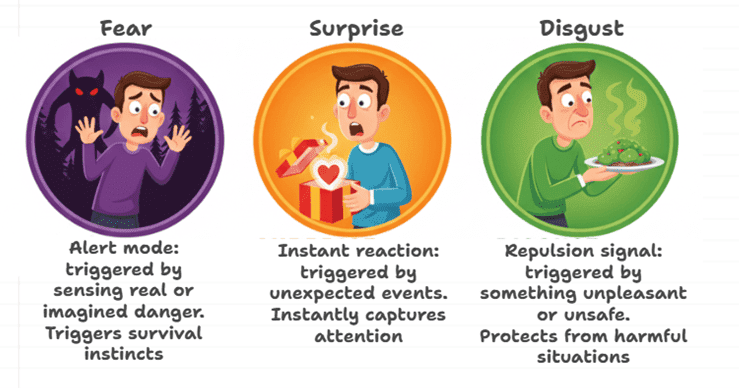
Fear: is a strong survival emotion which alerts us from real threat situations and sometimes from imaginary situations. It can be mild like nervousness & sometimes be intense like panic. Fear make us cautious but when exceed the limits , stops the growth of an individual.
Understanding and facing the fear provides us courage.
Surprise: is a sudden emotion which occurs when something unexpected happens, it can be either good or shocking. Surprise is a neutral emotion, it can be positive or negative. Here, positive surprise gives us excitement like gifts, good news or unexpected appreciation. Negative surprise shocks us , confuses us or create fear within us.
Surprise is a sudden spark that flips one’s mood in a second.
Disgust: is a strong negative emotion that happen when a person finds situation or thing, unpleasant, dirty or morally wrong. Its main purpose is to protect us from harmful or unsafe items. Disgust teaches us to set boundaries and to protect out values, either they are our health or our ethics.
Interesting fact: Watching disgust on person’s face triggers disgust emotions on another person too.
Did you know?
Facial expressions are natural, still people miss then. As per studies, people misses 70% of facial cues most of the time due to distractions, focusing only on words, overthinking, cultural filters, and simply because of lack of practice.
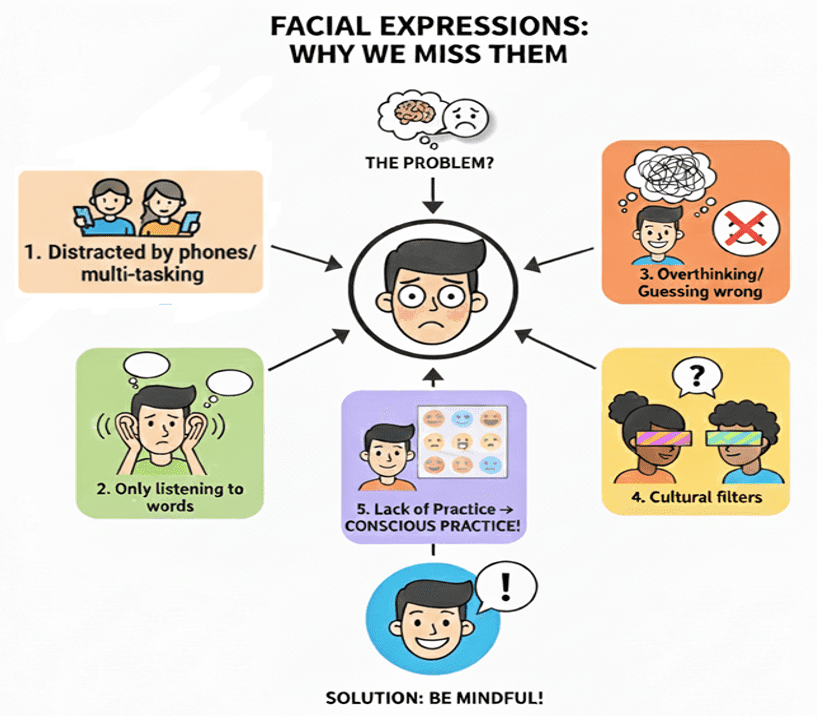
Challenge yourself:
For the next 7 days, while you are in some kind of conversation, keep your phone aside and observe these 3 things in another person: Eyebrows, Eyes and Mouth. You will be stunned after seeing how expressions changes during a conversation.
But to fully understand the situation: one have to watch expression, understand the concept and check for the body language of a person else you can interpret the situation incorrectly and take the wrong judgment.
Personality and facial expressions
Everyone shows facial expressions differently, this is generally because of individual’s personality, their upbringing or due to the profession they are on.
- Some people are naturally highly expressive, their face reveals every emotion they are having at the moment.
- Some people are low expressive, even during strong emotions, their face could give subtle hint.
- But some people mastered the poker face, reveling no emotions from their face.
We don’t have to judge person based on these factors, we just have to observe and understand their facial patterns to have better understanding of the emotions they are going with.
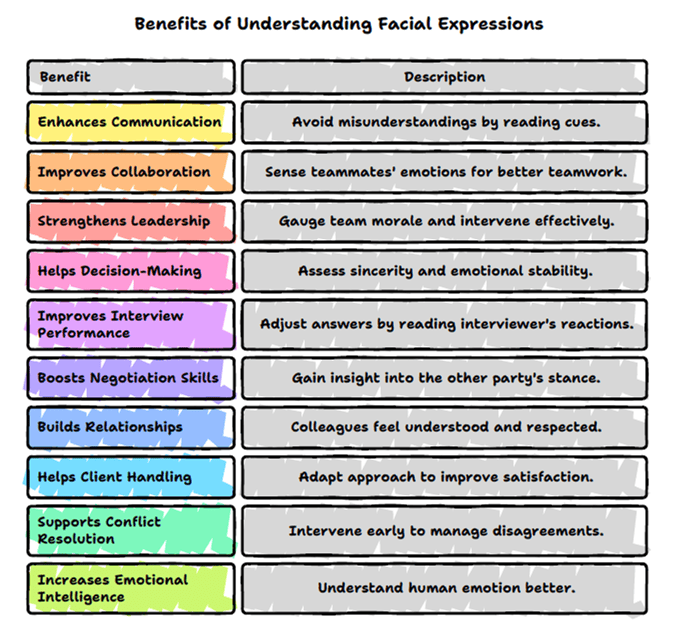
Case study
Imagine this: You are in a very important meeting with your team. Then your manager said: Great job team. Every member gets excited and looks toward one another to congratulate. But wait, something doesn’t add up.
Manager’s face shows no smile & there is no warmth in his eyes, his expressions are flat.
After noticing manager’s face, Will you believe his words or his face? His words doesn’t add up with his words, which can confuse the team.
Team might start thinking: Why his emotions and words are not matching? Did we really performed good? Is he under pressure from top management? Is he having problem in his personal life?
The only option the team will end up is in doubt.
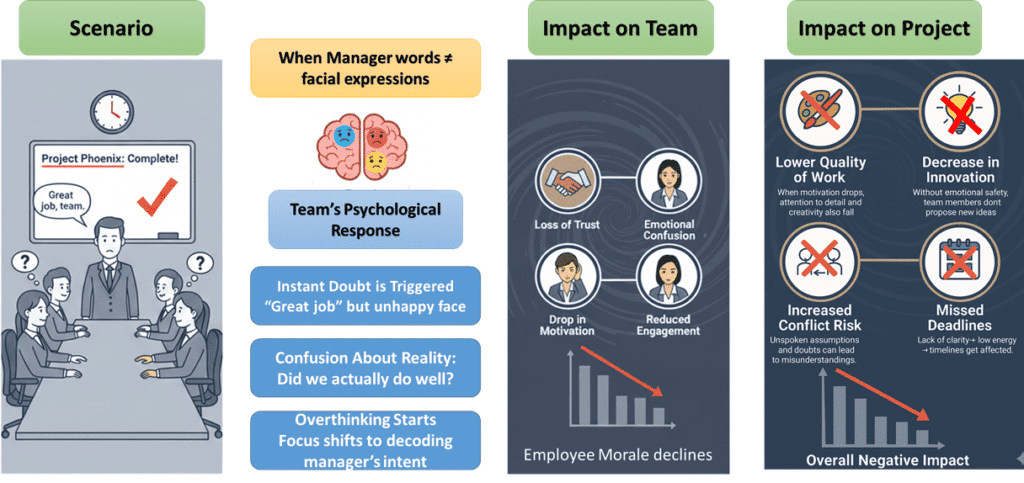
Psychologist often says: If words and face don’t match, trust the face. In such moments, you realize that facial expressions are the real truth as one can practice and manipulate the words but they can’t fake the emotions and expression of their faces.
Conclusion:
Facial expression is the most powerful tool of non-verbal language. It is universal in nature, gives instant & honest analysis of the situation, it is authentic but most importantly, it can be learnt.
If you constantly practice, observe, notice and connect the facial expressions. Then you’ll be able to read people by their expressions, before their words. It is a lifetime skill, it never goes to waste & it will only excels you in every aspect of your life.
So, with this, I will end this 2nd blog on Body Language Series: Facial expressions.
If you found this helpful…
- Save this guide for later
- Share it with someone who loves psychology, or someone who’s working on their self-growth.
And I will meet you soon with 3rd blog on first Universal Basic Emotions. Till then .. Bye & take care.
0 Comments